This article reflects current medical evidence and public Medicare Part B coverage rules. For personal medical advice or coverage details, please speak with your own clinician and insurer.
You notice a sore on your foot and the first thought is simple and scary: How do I keep this from costing me my leg? Many people living with diabetes in the Fort Worth area face that same fear, especially after a doctor visit or a hospital stay for infection.
Rising diabetes rates mean more foot ulcers and more preventable amputations. The good news is that focused diabetic wound therapy in Fort Worth can often change that story. With early care from a board-certified wound specialist, many people are able to heal faster, lower amputation risk, and get a large part of their care at home through mobile wound care or in a clinic setting.
Key Takeaways
- Most diabetes-related amputations start with a small, untreated foot ulcer, not a dramatic injury.
- Seeing a board-certified wound specialist the same week a sore appears can lower your amputation risk.
- Mobile wound care and clinic visits can bring advanced diabetic wound therapy in Fort Worth to your bedside or in-office, often Medicare Part B covered when rules are met.
- Advanced options like cellular tissue allografts and hyperbaric oxygen therapy can help certain non-healing wounds when basic care is not enough.
- Not every limb can be saved, but early, steady care gives you the best chance to heal at home and stay active.
Why Do Diabetic Foot Wounds Sometimes Lead to Amputation?
With diabetes, high blood sugar can damage nerves and blood vessels over time. That can cause neuropathy, so you may not feel pain in your feet, and poor circulation, so wounds get less oxygen and fewer nutrients. In plain terms, you may not feel the cut, it may not get good blood flow, and infection can find a home.
What to do:
- Check your feet every day, including between your toes and on the bottom.
- Do not ignore redness, blisters, drainage, or a new sore, even if it does not hurt.
- Search for a wound specialist and ask for a same-week visit when something looks off.
If an ulcer sits open, germs can spread deeper into tissue and sometimes into bone, a problem called osteomyelitis. Once infection reaches the bone, the risk of needing a major amputation goes up sharply. Saving the foot can turn into a race against time.
What to do:
- Expect your provider to order tests like X-rays, MRI, or blood work, not just another antibiotic.
- Ask, "Are you checking if this has reached the bone or deeper tissues?"
Delays add up. Waiting weeks for appointments, trying home remedies, or using random dressings can let a small sore grow out of control. Every week an open sore stays stuck, your risk of losing that toe, foot, or leg goes up.
What to do:
- Look for a board-certified wound specialist who treats diabetic feet all day, not once in a while.
- Ask if they offer mobile wound care or clinic appointments with same-week openings.
- Make sure they coordinate with your primary doctor and diabetes team.
What Is Diabetic Wound Therapy in Fort Worth?
Modern diabetic wound care rests on a few core pillars. Clinically, these include sharp debridement to remove dead tissue, moisture-balanced dressings, offloading to take pressure off the sore, infection control, and steady blood sugar management. In plain English, your team should clean out the bad tissue, keep the sore at the right moisture level, keep weight off it, fight germs, and help keep sugars steady.
What to do: ask any provider, "How will you handle each of these five areas for my wound?"
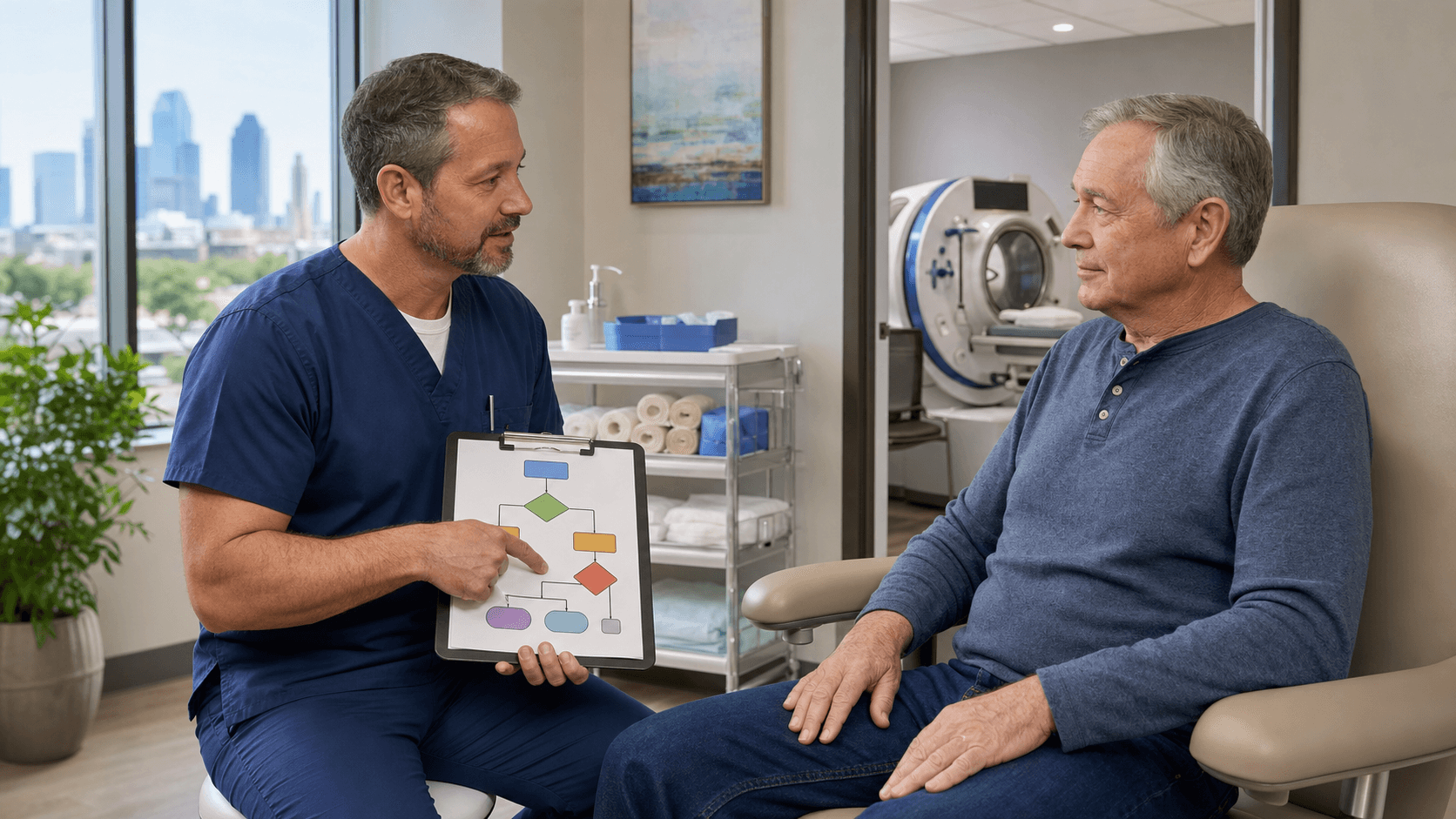
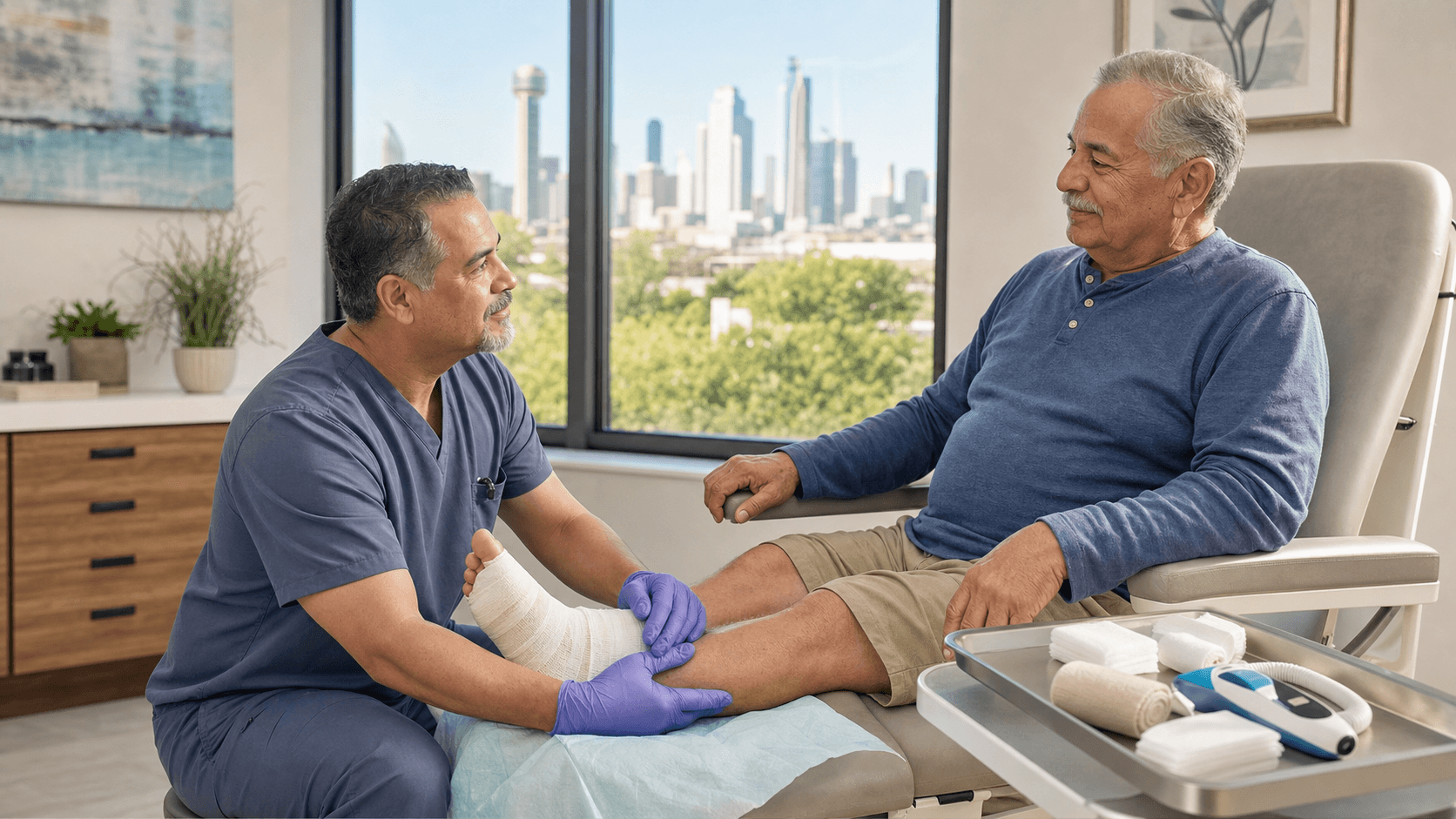
In the Fort Worth area, there are both mobile wound care options and clinic-based visits. Home-based, bedside care brings the wound specialist to you, which helps if walking or transport is hard. Clinic care can offer certain procedures or tools that are not always possible at home.
What to think about:
- Can you safely travel, or is bedside care safer for you right now?
- Do you need frequent visits to stay on track?
- Ask how Medicare Part B coverage works for your situation and whether home care criteria are met.
Sometimes, even with good basic care for 4 to 6 weeks, a wound will not close. At that point, advanced therapies like cellular tissue allografts, negative pressure wound therapy, and hyperbaric oxygen therapy (HBOT) may be considered based on clinical guidelines. In simple terms, if a sore is stuck, your team can sometimes add back missing skin signals or oxygen to help jump-start healing.
What to do: ask your wound doctor, "Is my ulcer a candidate for grafts or HBOT, and is it Medicare Part B covered for my diagnosis?"
Here is a simple comparison of common options.
Comparison Table: Where Does Diabetic Wound Care Often Happen?
Typical primary care / urgent care
Standard home health nurse
Board-certified wound specialist (clinic or mobile)
Same-week access
Sometimes for quick visits, but follow-up may be slower
Often based on agency schedule
Often available for high-risk ulcers, including new or worsening ulcers
Debridement capability
Limited, often basic only
Usually no sharp debridement
Can perform serial sharp debridement
Advanced dressings / grafts
Limited selection
Can place as ordered by a doctor
Regular use when clinically indicated
Vascular tests
Can order, but may not interpret daily
Does not order or interpret
Orders and interprets or works closely with vascular team
HBOT access / coordination
Usually refers out
Depends on supervising doctor
Able to identify candidates and coordinate care
Amputation prevention focus
Broad medical focus, not wound specific
General wound support
Central goal of the care plan
Medicare Part B covered options
Standard office services when rules are met
Nursing visits when criteria are met
Office or home services when rules and medical need are met
How Does Advanced Wound Therapy Help Prevent Amputation?
Cellular tissue allografts and similar biologic products are layers made from donated human or animal tissue that carry healing signals. They are used for chronic ulcers that have good blood flow but have stalled despite standard care, as described in multiple clinical studies (for example, in Diabetes Care and other peer-reviewed journals). In plain terms, your provider may place a signal-rich layer over your sore so your body remembers how to grow healthy skin again.
What to do:
- Ask if your blood flow has been checked with proper tests before using a graft.
- Grafts usually do poorly if circulation is not fixed first.
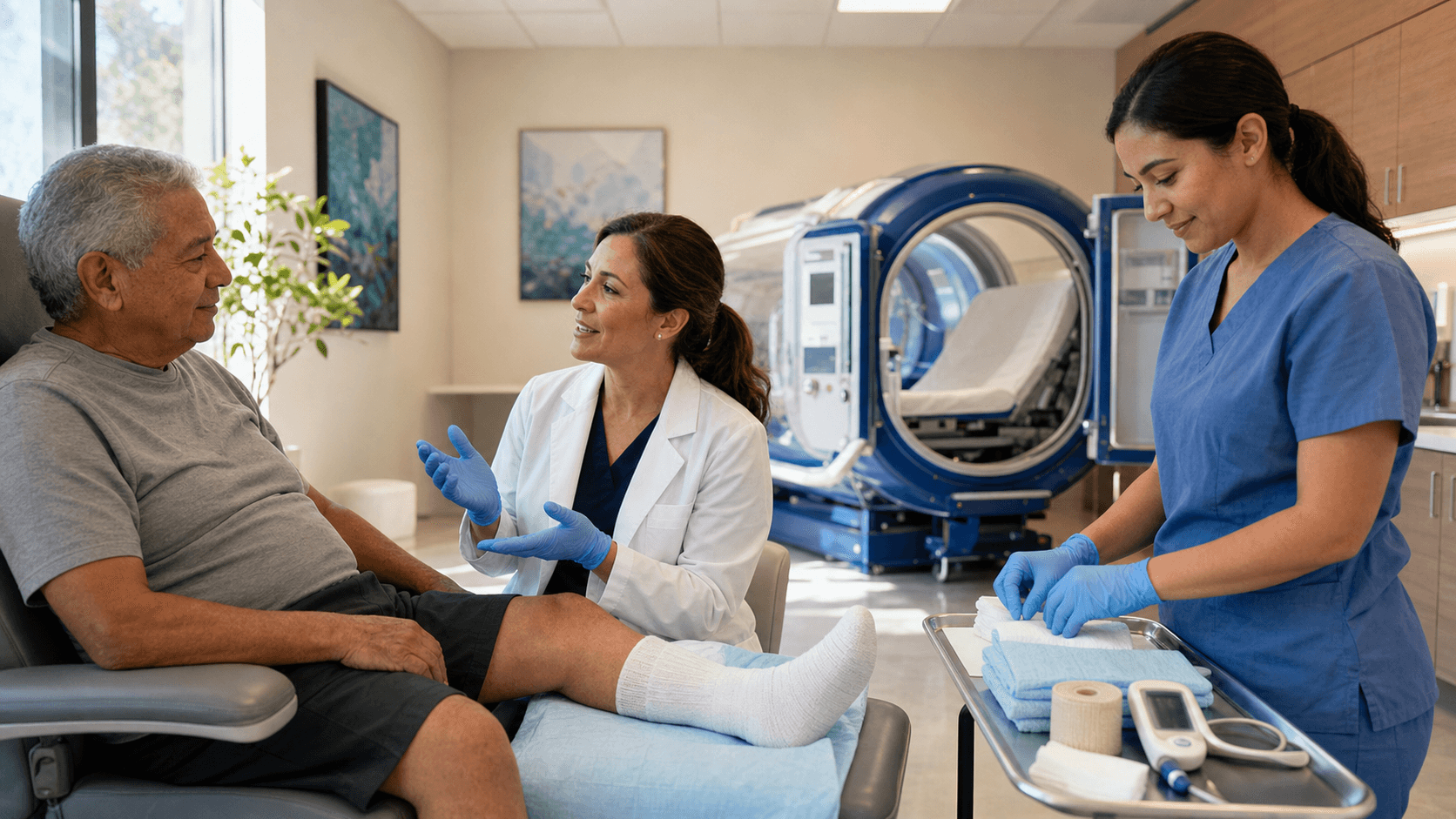
HBOT is a treatment where you breathe 100 percent oxygen at higher pressure in a special chamber. For some complex diabetic foot ulcers, this can help bring more oxygen to tissue and support new blood vessel growth, based on specific medical criteria published in guidelines and Medicare coverage policies. It is like putting your wound in an oxygen-rich environment so it can fight infection and repair better.
What to do:
- Ask if your ulcer meets medical and Medicare Part B coverage criteria after a trial of standard care.
- Talk about the time commitment, since HBOT usually needs many sessions each week.
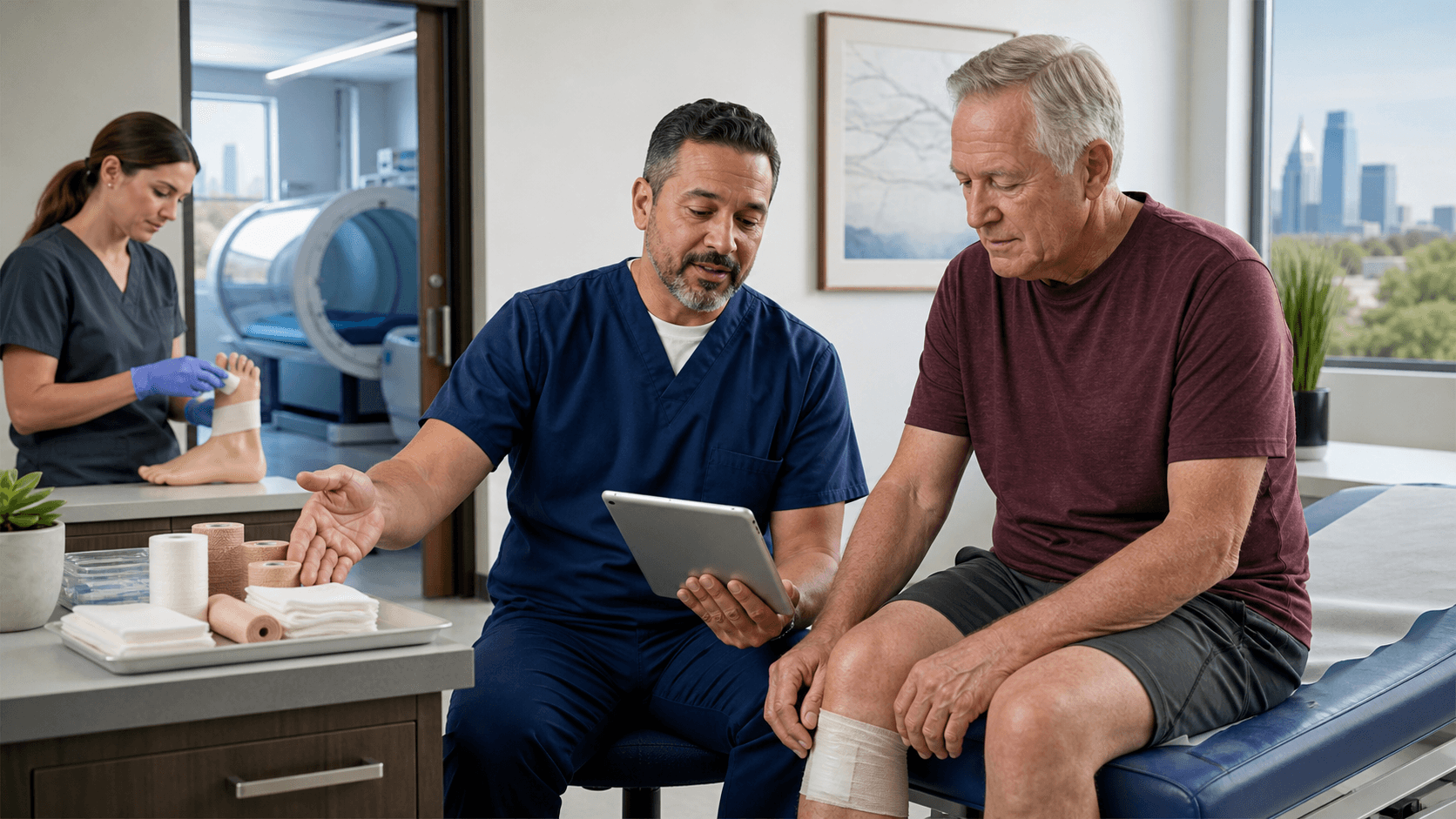
Advanced wound care is not a one-and-done visit. Amputation prevention depends on serial debridement, frequent dressing changes, offloading checks, and close infection watching. It is more like physical therapy for your wound: steady work over time, not a single magic treatment.
Dr. Brandon Elrod, DO, FAPWCA, Captain, US Army (Ret.), says, "Our mission is to give every patient a fair shot at keeping their limb, without overpromising what medicine cannot deliver. When we catch diabetic foot wounds early and stay on them week after week, we can often turn a likely amputation into a healed ulcer."
When Is It Too Late to Save a Foot or Leg?
Some warning signs mean you need the ER, not a routine clinic visit. These include spreading redness up the leg, fever or chills, a foul odor, fast-growing pain or swelling, black skin that looks dead, or feeling confused or short of breath. If a wound is rapidly worsening or you feel sick all over, it is safer to seek emergency care right away.
What to do:
- Call emergency services or go to the nearest ER.
- Later, ask the hospital team to include a board-certified wound specialist in your plan.
Sometimes amputation is actually the safest option. This can be true when tissue has died and cannot be saved, when bone infection will not clear, when sepsis threatens your life, or when a limb no longer works and causes constant pain. In plain terms, keeping a badly infected limb can risk your life, while a lower-level amputation can sometimes get you back to walking and home faster.
What to do:
- Ask for clear, honest talk about why amputation is being advised.
- Ask about likely walking ability, prosthetic options, and rehab after surgery.
- Getting a second opinion is reasonable if you are unsure.
Honest goal setting matters. You deserve straight talk about your chances to heal at home, the effort it will take, and what happens if certain treatments fail. Bringing a trusted family member, writing down questions, and asking your doctor to walk you through pictures and test results can help you feel more in control.
How Do I Choose a Diabetic Wound Specialist?
A board-certified wound specialist has formal wound care training and focuses on complex wounds every day. That is different from someone who only changes dressings once in a while. You want someone who works with diabetic foot ulcers all day, knows the current evidence, and can explain it in plain language at your bedside or in the clinic.
What to do:
- Ask about their wound care training and certifications.
- Ask how many diabetic foot ulcers they manage on a regular basis.
- Ask how they share notes with your primary doctor, endocrinologist, and podiatrist.
Access and logistics matter too, especially around Fort Worth where travel can be tiring. Same-week appointments, mobile wound care, and good HBOT referral networks can all help keep you out of the hospital when it is safe to be at home. If it is hard to get to the office, having someone come to your bedside could be the difference between healing and giving up.
What to check:
- Do they serve your neighborhood with mobile visits or nearby clinic times?
- Are services typically Medicare Part B covered when medical needs are met?
- Do they help with paperwork and prior authorizations, so you are not left to figure it out alone?
At your first diabetic wound visit, you should feel like your foot is getting a full, organized workup. That often includes careful measurement and photos of the wound, a plan to check circulation, infection screening, a look at your shoes and offloading devices, and a talk about glucose control. If your first visit feels rushed and you leave without a clear plan, that is a warning sign.
What to expect to leave with:
- A written wound care plan and dressing instructions.
- A clear list of medicines or tests ordered.
- A booked follow-up visit within a set time frame.
Frequently Asked Questions About Diabetic Wound Therapy
Q: How fast should I see a wound doctor after noticing a new foot sore?
A: Aim for the same week, especially if you have neuropathy, poor blood flow, or any past ulcers. Early assessment allows faster treatment and can lower the chance that the sore will lead to infection and amputation.
Q: Is mobile wound care covered by Medicare Part B?
A: Medicare Part B may cover certain wound care services when they are medically necessary and when homebound or other criteria are met, according to Medicare.gov and local coverage determinations. A wound practice can usually review your situation, explain the rules in plain language, and help check your benefits.
Q: How long does it usually take a diabetic foot ulcer to heal?
A: Healing time depends on size, depth, blood flow, and infection. Many ulcers can heal in weeks to a few months with steady care, while more complex wounds may take longer or, in some cases, may not fully close despite treatment.
Q: Will I definitely avoid amputation if I start advanced wound therapy?
A: No treatment can promise limb salvage. Early, complete care can lower risk, but things like blood flow, infection, kidney function, and overall health all play a role in the final outcome.
Q: Can I really heal at home, or do I need to stay in the hospital?
A: Some people with stable wounds and good support can heal at home with mobile wound care and clinic check-ins. Others with severe infection, fast-spreading redness, or serious medical problems may need hospital care first, then transition to bedside or clinic-based follow-up.
Q: What should I bring to my first diabetic wound visit?
A: Bring a list of all medicines, recent lab results, hospital records, and any photos you have of the wound from earlier stages. Bring your current dressings, any offloading boots or shoes, and a family member or friend if possible so you have another set of ears for the plan.
Take the Next Step to Heal at Home
If you have a diabetic foot sore, you do not have to wait and hope it gets better on its own. To ask about same-week visits with a board-certified wound specialist and mobile wound care near you, call us at [--X] or book online at [--URL]. Most services are Medicare Part B covered when medical and homebound criteria are met, and Dr. Brandon Elrod, DO, FAPWCA, personally oversees pre-authorizations so you understand your options before treatment begins.
Take Control Of Your Diabetic Wound Healing Today
If you or a loved one is struggling with a non-healing foot ulcer, Anchor Wound Management is ready to help you take the next step toward recovery. Our specialists provide targeted diabetic wound therapy in Fort Worth designed to protect your health and mobility. Reach out to our team to discuss your situation, review treatment options, and schedule an appointment. If you are ready to get started, you can contact us today.