How to Choose the Safest Place for Your Wound to Heal
When a new wound shows up, the first question is usually simple: where do I go right now? ER, wound clinic, home health, or can someone come to me at my bedside? In Dallas and Fort Worth, there are many options, and that can make the choice even harder.
This guide walks through how different wound types and symptoms point to different settings. Our goal is to help you heal faster, avoid hospital stays and amputation when possible, and still stay safe if you want to heal at home.
Key Takeaways
The right wound care setting depends on wound type, infection signs, and how easy it is for you to travel.
Many stable wounds can be safely managed with mobile wound care at your bedside in the same week.
Diabetic foot, post-surgical, pressure, and venous leg wounds each have their own rules for where to start.
In Dallas, wound care services in Dallas, TX include hospital, ER, clinic, home health, and mobile wound specialists, and each has limits.
Medicare Part B-covered options may allow you to heal at home with a board-certified wound specialist when criteria are met.
Anchor Wound Management is a Dallas, Fort Worth wound care group that brings mobile wound care at your bedside, advanced therapies, and hyperbaric oxygen treatment to patients with complex wounds. Our clinical leadership, including Dr. Brandon Elrod, DO, FAPWCA, focuses on disciplined follow-through and bedside kindness to help prevent limb loss when possible.
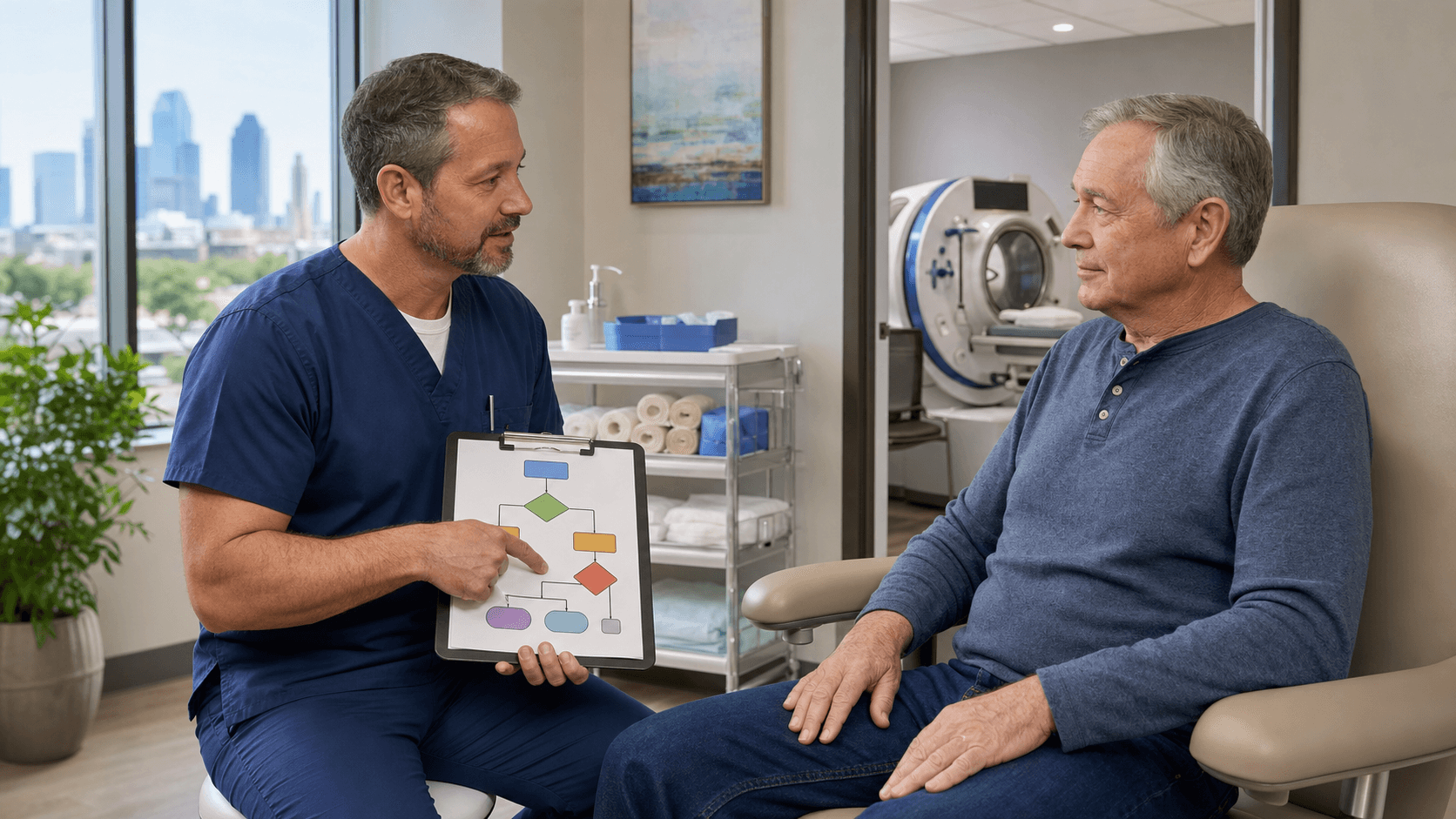
Decision Rules: ER, Clinic, or Heal at Home
Clinical fact: Signs of whole-body infection, also called sepsis, need emergency care. The CDC notes that fever, chills, confusion, fast heart rate, fast breathing, and rapidly spreading redness or black tissue around a wound can point to serious infection.[1]
Plain-English: If your body feels sick all over or the wound suddenly looks or smells much worse, do not wait for a same-week visit.
What to do: Call 911 or go to the closest ER right away if you see these red flags.
Clinical fact: A wound that has not improved after several weeks of basic care is often called chronic. Research supported by the NIH shows that these wounds are less likely to heal without focused treatment from someone trained in advanced wound care.[2]
Plain-English: If you keep changing bandages and it looks the same or worse week after week, it is time for a board-certified wound specialist.
What to do: If you can travel safely, an outpatient clinic is reasonable. If walking, transfers, or transportation are hard, mobile wound care at your bedside in the same week may be a safer start.
We focus on four common types that often need more than simple care:
- Diabetic foot wounds
- Post-surgical wounds
- Pressure ulcers (bedsores)
- Venous leg ulcers
Clinical fact: These wounds have different risks, including bone infection and amputation, as shown in peer-reviewed data on diabetic foot ulcers and pressure injuries.[3][4]
Plain-English: Two open sores can look similar on the skin but one might be close to bone, or linked to poor blood flow.
What to do: Match the wound type and your symptoms to the setting, then adjust quickly if anything changes.
Diabetic Foot and Post-Surgical Wounds: When Home Is Safe
Clinical fact: The CDC reports that diabetic foot ulcers are a major cause of preventable lower-limb amputation. Nerve damage and weak blood flow mean small sores can hide deep problems.[5]
Plain-English: A "tiny" sore on a diabetic foot can be a big deal, even if it does not hurt much.
What to do: Check feet every day. Any new blister, redness, or open spot should be seen within the same week by a wound expert in Dallas, Fort Worth.
For diabetic foot wounds, think in three paths:
- Path A, ER or hospital: Fever, spreading redness, foul odor, black tissue, or sudden swelling means go to the ER now.
- Path B, clinic: New wound, no strong infection signs, and you can travel. Start with a clinic or hospital-based wound center.
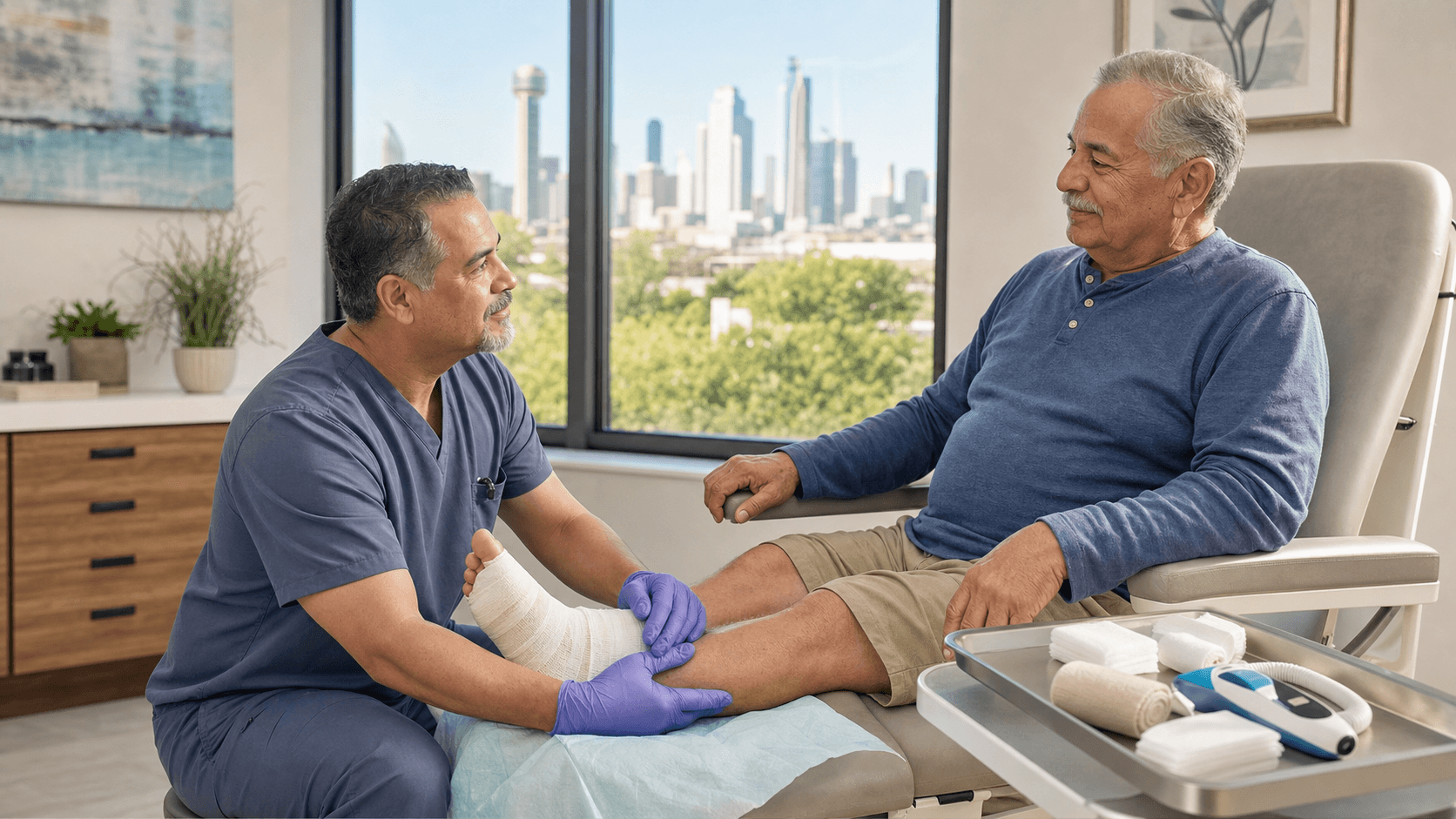
- Path C, mobile wound care: Trouble walking, recent hospital stay, dialysis, or past amputation. A board-certified wound specialist at your bedside can help you heal at home if it is safe.
Dr. Elrod often reminds patients, "With diabetic foot, speed and accuracy matter. Sometimes the safest move is surgery first, then careful mobile wound care at your bedside so you can finish healing at home."
Clinical fact: Post-surgical wounds can open up, get infected, or collect fluid even after a clean operation, according to NIH surgical wound guidance.[6]
Plain-English: If your stitches gap, leak, or smell bad, something inside may not be healing as planned.
What to do: Call your surgeon first if possible. If you have fever or severe pain, go to urgent care or the ER. If the incision is open but you are otherwise stable, same-week mobile wound care in Dallas, TX can often support healing at home with your surgeon's input.
Safe at-home post-surgical care usually means:
- No high fever
- No heavy, uncontrolled bleeding
- Pain is manageable with pills
- You can drink fluids and take oral medicine
- Your surgeon agrees with outpatient wound management
At your bedside, a wound team can use advanced dressings, negative pressure wound therapy, and regular visits to help the area fill in and close. Many of these services and supplies can be Medicare Part B covered when medically necessary, but final decisions follow Medicare.gov rules.[7]
Pressure Ulcers, Venous Ulcers, and Care Settings
Clinical fact: The Agency for Healthcare Research and Quality notes that pressure injuries form when skin over a bone is pressed for hours, cutting off blood flow. This is common in people who stay in one position in a bed or wheelchair.[8]
Plain-English: If someone cannot move often, the skin on the tailbone, hips, and heels can break down and die.
What to do: Any new red area that does not fade, blister, or open sore in a bedbound person should trigger quick evaluation. Mobile wound care in Dallas, Fort Worth is often safer than moving a fragile patient, unless there are ER red flags.
Clinical fact: Venous leg ulcers are tied to poor vein function and swelling. Studies show they heal slowly without compression and regular wound care.[9]
Plain-English: If your lower legs stay swollen, leak fluid, and the skin cracks, the veins are not pushing blood back to your heart well.
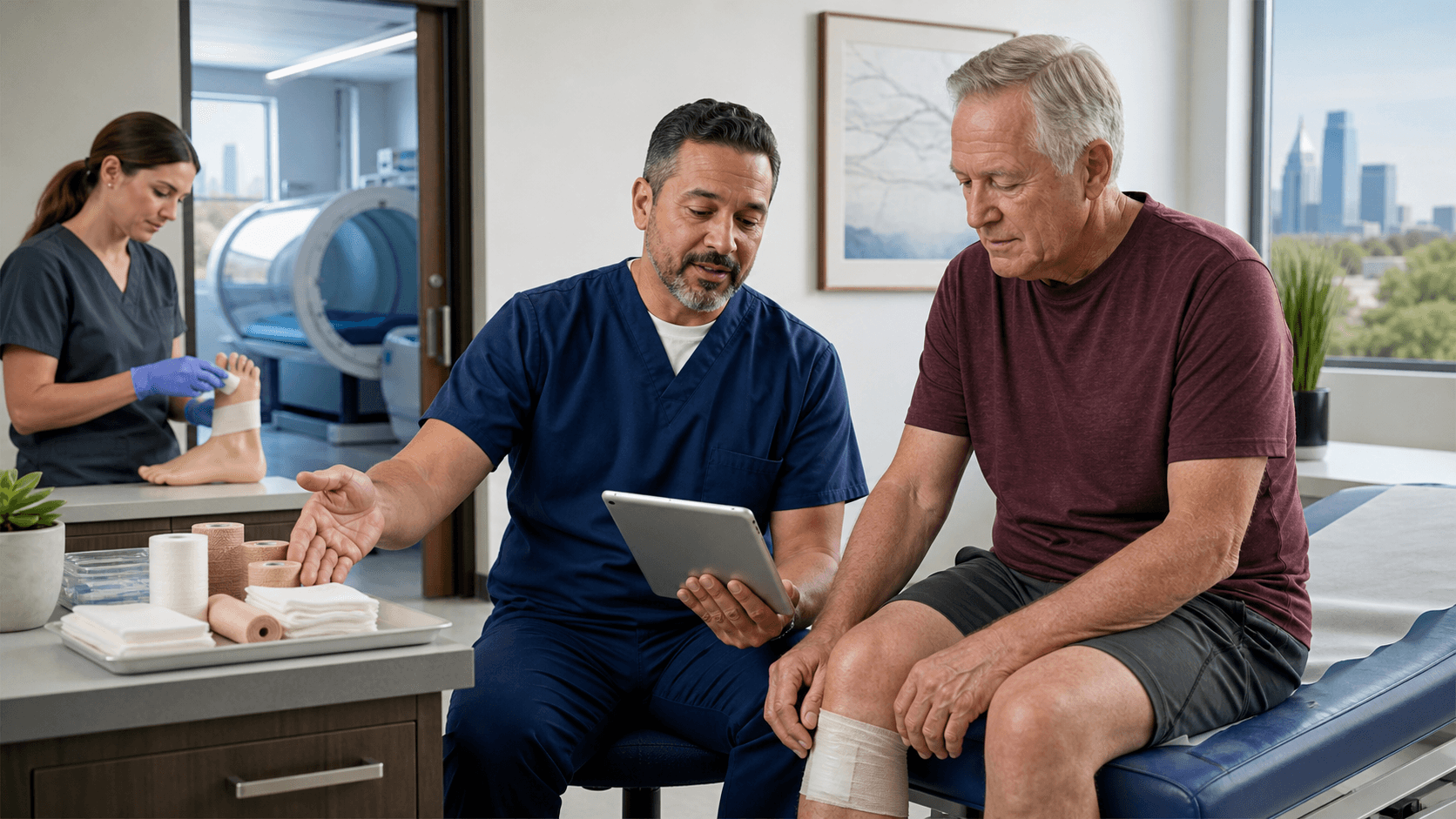
What to do: Some people do best with clinic-based vascular tests plus wound care. Others with high fall risk, no easy ride, or severe swelling may be better served by a board-certified wound specialist at your bedside using compression and dressings to help you heal at home.
Comparing Wound Care Settings
Setting
Ideal for
Speed
Travel
Services
Limits
ER
Any wound with sepsis signs, heavy bleeding, or sudden severe pain
Same day, usually right away
You must go in or call 911
Imaging, IV antibiotics, emergency surgery
Not for long-term wound follow-up
Hospital inpatient
Deep infections, bone infection, very sick patients
Same day if admitted from ER
Inpatient stay
Surgery, advanced imaging, IV therapy
Short term, transition plan needed
Outpatient wound clinic
Stable but complex wounds, able to travel
Scheduled, often weekly
You or a caregiver must drive
Debridement, advanced dressings, some procedures
Hard for people with mobility or transport problems
Mobile wound care at home
Stable but serious wounds, poor mobility, high fall risk
Often same week visits
None, care at your bedside
Assessment, debridement, advanced dressings, care coordination, sometimes hyperbaric referrals
Not a replacement for emergency surgery or ICU care
Nursing facility
Ongoing daily help with turning, hygiene, and basic dressings
Depends on placement
You live there
Routine care, some wound treatments
May still need outside board-certified wound specialist visits for complex cases
Getting Ready for Safe Wound Care
Before you call any wound care provider, it helps to gather:
- A list of all medicines, including insulin and blood thinners
- Blood sugar readings if you have diabetes
- Photos of the wound over time if you have them
- Any recent hospital or surgery records
- Insurance or Medicare cards
Plain-English: The more organized your story is, the faster a clinician can judge if it is safe for you to heal at home or if you need ER or hospital care first. Involve family or caregivers early, especially with pressure ulcers and venous ulcers that need daily turning, elevation, and help with compression.
Good questions to ask any wound care team:
- Are you a board-certified wound specialist or working closely with one?
- How fast can you see me, can I get a same-week visit?
- What can you safely do at my bedside, including debridement or advanced dressings?
- How will you coordinate with my primary doctor, surgeon, or kidney and heart doctors?
- Which services might be Medicare Part B covered, and what should I confirm with Medicare.gov or my plan?
If your wound is not improving after several weeks, if pain is getting worse, or if the plan does not make sense to you, it is reasonable to look for more input. A second set of eyes can help you avoid preventable hospital stays or amputation when possible.
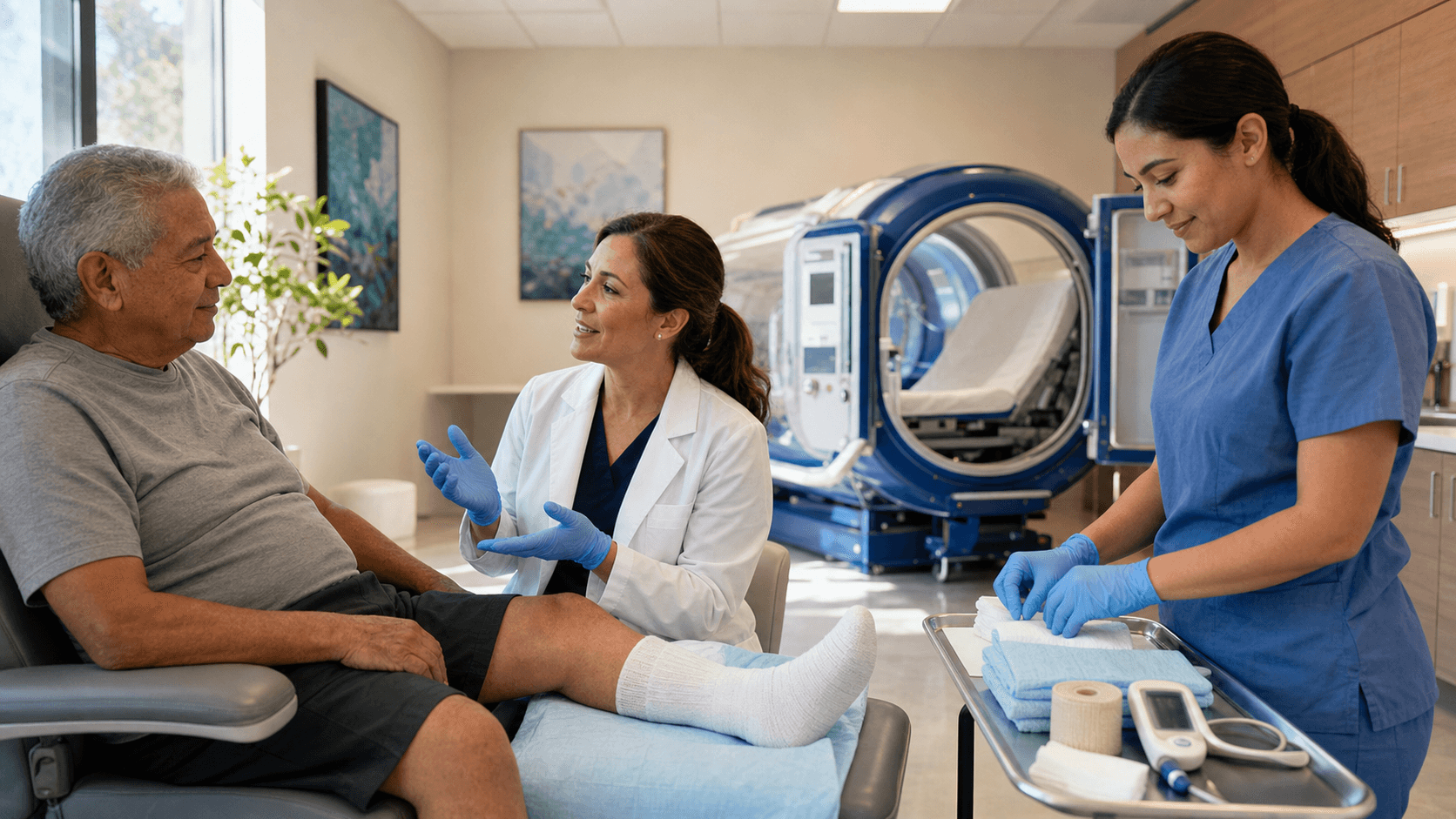
Anchor Wound Management serves patients across Dallas, Fort Worth with mobile wound care at your bedside, advanced therapies, and access to hyperbaric oxygen treatment when appropriate. Our approach, shaped in part by Dr. Elrod's experience as a Captain, US Army (Ret.), is to be clear, steady, and honest about when home is safe, when clinic is better, and when hospital or surgery is not optional.
FAQ: Choosing Wound Care Services in Dallas, TX
Q1: How do I know if my wound is an emergency instead of a same week issue?
A: Fever, chills, confusion, streaking redness, sudden severe pain, black tissue, or foul-smelling drainage are red flags that point to the ER.[1] A stable open wound without whole-body symptoms is usually better suited to clinic or mobile wound care.
Q2: Can I really heal at home with a serious wound?
A: Many diabetic foot, post-surgical, pressure, and venous ulcers can be managed at your bedside if you are medically stable and seen regularly by a board-certified wound specialist.[2, 5, 9] Deep infection, heavy bleeding, or severe illness still call for hospital or surgical care first.
Q3: Are mobile wound care visits Medicare Part B covered in Dallas, Fort Worth?
A: Many medically necessary physician and certain practitioner services provided in the home can be covered under Medicare Part B when rules are met.[7] Coverage is based on current Medicare.gov guidance, so it is important to confirm details for your specific situation.
Q4: What is the difference between home health nursing and a bedside visit from a wound specialist?
A: Home health nurses focus on routine care and dressing changes. A board-certified wound specialist performs advanced assessment, can do debridement, designs the overall plan, and coordinates treatments like hyperbaric oxygen or surgery when needed.
Q5: How fast can mobile wound care usually see new patients?
A: Response times vary, but many non-emergency cases are evaluated within a same-week window, with quicker triage when infection risk is high. Emergency symptoms should still go straight to the ER.
Q6: Do I still need my primary doctor or surgeon if a mobile wound team is involved?
A: Yes. Wound care works best as part of a team. Your primary doctor, surgeon, heart, kidney, and diabetes doctors all play key roles, and a good wound team keeps them informed so your whole plan stays aligned.
Clinical and coverage sources:
[1] Centers for Disease Control and Prevention (CDC). Sepsis: Symptoms, Causes, and Treatment.
[2] National Institutes of Health (NIH). Chronic Wounds and Impaired Healing.
[3] Armstrong DG, Boulton AJM, Bus SA. Diabetic Foot Ulcers and Their Recurrence. N Engl J Med. 2017.
[4] National Pressure Injury Advisory Panel (NPIAP) and related peer-reviewed guidelines.
[5] CDC. Diabetes and Lower Extremity Amputations.
[6] NIH. Surgical Wound Infection Factsheet.
[7] Medicare.gov. What Part B Covers, Outpatient and Physician Services.
[8] Agency for Healthcare Research and Quality (AHRQ). Preventing Pressure Ulcers in Hospitals.
[9] O'Meara S, Cullum N, Nelson EA. Compression for Venous Leg Ulcers. Cochrane Database Syst Rev.
Take The Next Step Toward Healthier Healing
If you or a loved one needs advanced attention for complex or nonhealing wounds, our team at Anchor Wound Management is ready to come to you. Explore our specialized wound care services in Dallas, TX to receive bedside care designed around your specific needs. We will coordinate with your existing providers to create a focused plan that supports comfort, safety, and faster healing. To schedule an appointment or ask a question, please contact us today.