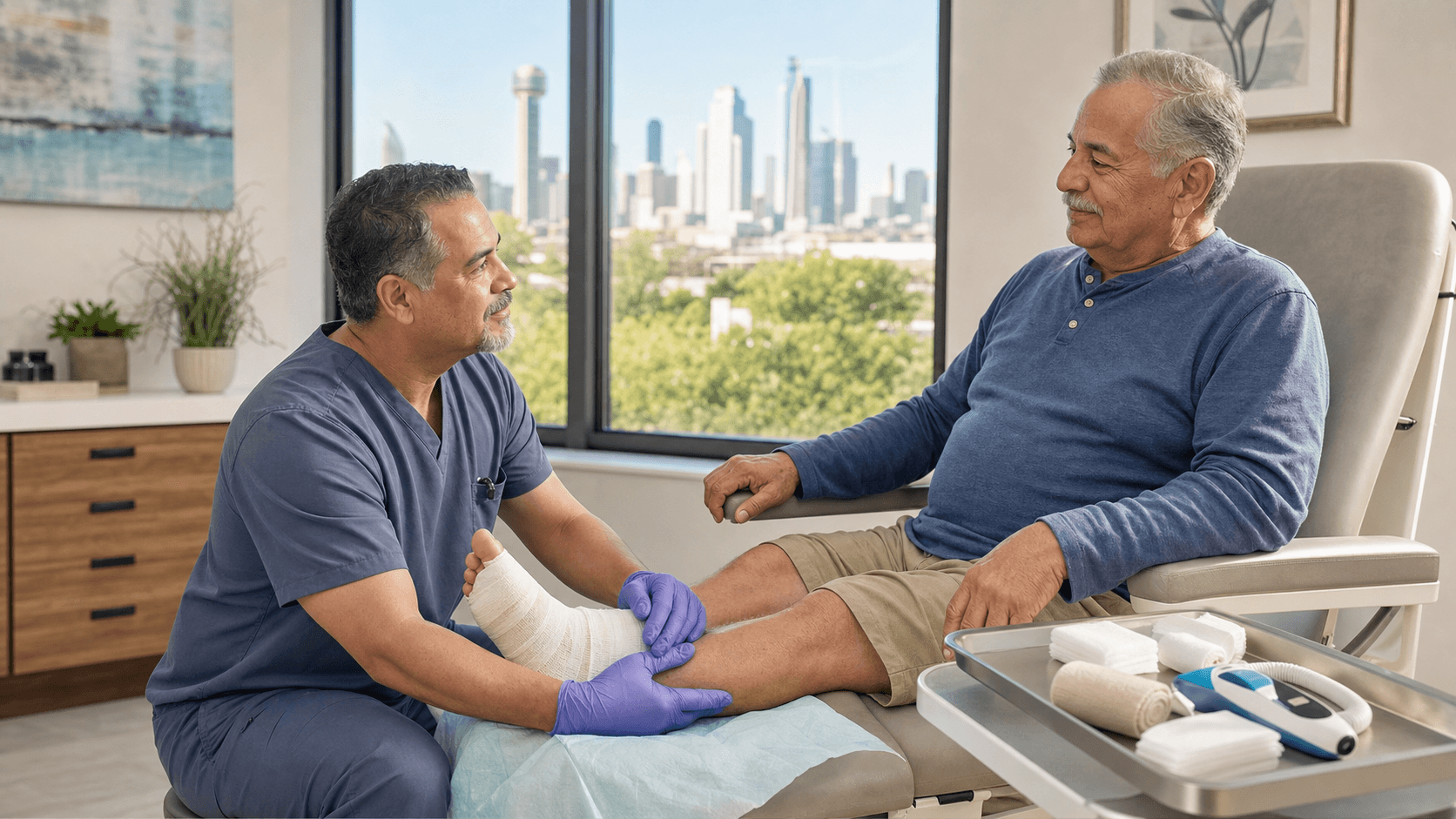
When a Diabetic Foot Starts Hurting in Dallas
When a diabetic foot suddenly looks red, swollen, or starts to hurt, the first question is simple and scary: do you go to the ER, urgent care, or can someone safely see you at home today in Dallas? That choice affects how fast you get antibiotics, imaging, and expert wound care, and it can change the chance of bone infection or amputation.
Diabetic foot infections are a medical emergency when they are moderate or severe. Infection can spread through soft tissue to the bone, and from there into the bloodstream, which can lead to sepsis. Here we lay out a same-day and same-week action plan so you know your first steps, what to ask about antibiotics, cultures, and imaging, when mobile wound care at your bedside is safer than sitting in an ER, and when the ER is not optional.
Key Takeaways
- Go to the ER now if you have high fever, spreading redness, confusion, black tissue, or feel very sick.
- Same-week mobile wound care at your bedside may be safe if redness is mild, you feel well, and the problem is limited to the foot.
- Moderate to severe infections usually need antibiotics started that same day, often before all test results return.
- Wound cultures and imaging like X-ray or MRI help find bone infection and guide longer-term treatment.
- A Board-certified wound specialist can often help you heal at home with Medicare Part B-covered mobile wound care that may reduce hospital stays.
How to Tell Mild Redness From a Limb-Threatening Infection
Clinical fact: Guidelines from groups like the Infectious Diseases Society of America (IDSA) and the NIH describe diabetic foot infections as mild, moderate, or severe based on how deep and how widespread the infection is, and whether the whole body is affected.
Plain-English translation: Mild means infection is small and shallow in the skin, moderate means the redness is spreading or going deeper but you still feel mostly okay, and severe means your whole body is reacting with fever, chills, or low blood pressure.
What to do: Use this simple scale to decide how urgent your situation is and whether you need the ER this hour, same-week mobile wound care near you, or a clinic visit.
Quick self-check at home (same day):
- Color changes: Is the skin bright red, purple, or turning black?
- Swelling: Is the foot or leg puffy or tight compared with the other side?
- Drainage and odor: Any pus, cloudy fluid, or new bad smell?
- Temperature: Does the foot feel hot compared with the other foot?
- Pain and pressure: Can you stand or walk, or is the pain new and severe?
Clinical fact: Severe infections with spreading redness, high fever, or confusion can lead to sepsis and higher amputation risk.
Plain-English translation: If your whole body feels sick, the infection is not just in your skin anymore, and home care is not safe.
What to do: Go to the ER or call 911 if:
- Redness is racing up the foot or leg.
- You have fever, chills, or feel weak or confused.
- Your blood sugar is much higher than usual and will not come down.
- You see new black or gray tissue on toes or foot.
Clinical fact: Mild infections without systemic signs can often be treated safely as an outpatient with close follow-up, according to IDSA- and NIH-aligned guidance.
Plain-English translation: If the problem is small, you feel well, and it is only on the foot, it may be safe to stay home and be seen quickly by a mobile wound care team or in clinic.
What to do: Same-week mobile wound care or clinic may be safe if:
- Redness is small, close to the wound, and not spreading.
- You have no fever, no chills, no confusion.
- The wound is on the foot only, and you can safely stay at home.
Comparison Table: ER vs Mobile Wound Care vs Clinic Visit
| Situation | Safest first stop | Why | What usually happens |
|--------------------------------------------------------|------------------------------------------------|----------------------------------------------------|--------------------------------------------------------------------------------------|
| High fever, spreading redness, or confusion | ER | You may need fast IV antibiotics and admission | Blood tests, imaging, wound evaluation, IV fluids, and surgical consult if needed |
| New ulcer with mild redness, no systemic symptoms | Mobile wound care at your bedside | Early expert assessment at home can limit spread and start care quickly | Exam, cleaning, possible culture, dressing, offloading, and planning for imaging if needed |
| Chronic wound not healing but no new infection | Clinic visit with a Board-certified wound specialist | You may need advanced therapies, offloading plans, and imaging | Full wound workup, review of causes, and a clear treatment plan |
Same-Day Moves: Cleaning, Photos, and Glucose Control
Clinical fact: Research cited by the CDC and NIH shows that high blood sugar and delayed local care make infections harder to control and slow healing.
Plain-English translation: What you do today, even before any doctor sees you, can slow damage and help you heal at home.
What to do right now (safe same-day steps):
- Gently remove shoe and sock; do not rip off stuck material.
- Rinse the area with clean tap water or saline if available.
- Pat dry with clean gauze or a clean towel; do not scrub or cut skin.
- Cover with a simple, clean dressing, not tight plastic wrap.
- Do not apply harsh chemicals, strong antiseptics, powders, or home remedies unless a clinician has told you to use them.
Clinical fact: Good documentation with photos and glucose logs helps your future care team make faster, safer decisions.
Plain-English translation: Clear pictures and blood sugar numbers save time and can keep you out of the hospital.
What to do:
- Take clear photos of the top, bottom, and sides of the foot.
- Get a close-up of the wound and a wider shot to show where it is.
- Turn on date and time stamping if possible.
- Check and record your blood sugar and compare it to the target range your diabetes clinician has set.
Clinical fact: High glucose levels feed bacteria and weaken the immune response.
Plain-English translation: The higher your sugar runs, the easier it is for infection to grow.
What to do:
- Follow your diabetes plan to bring glucose back toward your target range.
- Call your diabetes clinician if numbers are far above goal or not improving.
Clinical fact: Pressure on an infected foot can deepen tissue damage.
Plain-English translation: Walking on a sore, infected foot can turn a small problem into a bigger one.
What to do:
- Do not walk barefoot, even indoors.
- Use a post-op shoe or avoid full weight on the affected foot if it is painful.
- Avoid long walks or standing until a professional says it is safe.
Who to Contact First Near You
Clinical fact: Early contact with the right clinician within 24 to 48 hours of new redness or drainage lowers the risk of serious complications, according to CDC- and NIH-aligned recommendations.
Plain-English translation: Calling someone the same day or same week is safer than waiting to "see what happens."
What to do:
- Reach out to one of the following: primary care, podiatry, a Board-certified wound specialist, or a mobile wound care service that can see you at your bedside.
- Have this information ready: when the problem started, your blood sugar numbers, any fever or chills, and a list of your medications and allergies.
Antibiotics, Cultures, Imaging, and When Mobile Care Is Safest
Clinical fact: For moderate or severe diabetic foot infections, expert groups like IDSA recommend starting antibiotics the same day to limit spread, while still getting cultures and imaging to plan longer treatment and look for osteomyelitis (bone infection).
Plain-English translation: You may need fast antibiotics to protect your foot and your life, but your team still needs good information from cultures and scans.
What to do: Expect your clinician to balance speed and information, starting treatment quickly while still arranging cultures and imaging.
Clinical fact: Non-infected ulcers often heal with good topical care, offloading, and glucose control without systemic antibiotics.
Plain-English translation: Not every open sore needs pills or IV antibiotics, but any sign of infection does.
What to do:
- Topical care alone may be enough when:
- The ulcer is clean, shallow, and not infected.
- There is no new redness, warmth, pain, swelling, drainage, or odor.
- Oral or IV antibiotics are usually needed when:
- Redness spreads beyond the wound.
- There is pus, foul odor, or deep tissue exposed.
- You have fever, chills, or feel sick.
Clinical fact: Cultures taken from deeper tissue after gentle cleaning are more accurate than surface swabs.
Plain-English translation: Where and how the sample is taken matters for choosing the right antibiotic.
What to do:
- Ask your clinician if they can obtain a proper culture (often during debridement) before or shortly after antibiotics start, depending on urgency.
Clinical fact: Imaging such as plain X-ray, ultrasound, or MRI helps detect bone infection, gas, or hidden fluid pockets.
Plain-English translation: Pictures of your foot show problems that the eye and fingers cannot see.
What to do:
- Expect imaging the same day in the ER for severe cases.
- Expect same-week imaging through a clinic or mobile wound care plan for stable patients.
Clinical fact: Some stable patients can safely receive oral or even IV antibiotics at home with coordinated mobile wound care and home health.
Plain-English translation: With the right team, you may be able to heal at home instead of staying in the hospital.
What to do:
- Ask if your infection is safe for home treatment with mobile wound care at your bedside.
- Understand that hospital care is still needed if you have unstable vital signs, fast-spreading infection, or need urgent surgery.
A Board-certified wound specialist helps decide what is safe at home. In our practice, Dr. Brandon Elrod, DO, FAPWCA, guides these choices. As he often says, "We bring military precision and bedside compassion to every diabetic foot, but we are honest when the safest place is the OR and the inpatient team."
Escalation Plan: Keeping You Safe Over Time
Clinical fact: Even with strong mobile wound care and clinic treatment, some infections get worse and need rapid escalation to surgery or inpatient care. Peer-reviewed studies show that delayed escalation is linked with higher amputation risk.
Plain-English translation: You and your wound team need a clear "if this, then that" plan so no one is guessing at midnight.
What to do: Watch for red flags after initial treatment and act quickly if they appear.
Red flags after initial treatment:
- More pain, especially deep or throbbing pain.
- New foul odor or sudden increase in drainage.
- Redness spreading beyond the marked line.
- New black, gray, or mushy tissue.
- Sudden jump in blood sugar for no clear reason.
- Fever, chills, nausea, or feeling generally unwell.
Clinical fact: Regular, measurable tracking of wound size, depth, tissue quality, and drainage helps predict which wounds are on track and which need escalation.
Plain-English translation: Your wound should be clearly changing for the better within days, not just "looking about the same" for weeks.
What to do:
- Expect your Board-certified wound specialist to:
- Measure wound size and depth.
- Track drainage amount and type.
- Check tissue color and quality.
- Set specific time points to see improvement.
If the wound is not improving or is getting worse, your team may:
- Change dressings or offloading.
- Adjust antibiotics based on culture results.
- Order or repeat imaging.
- Recommend ER evaluation or surgical consult.
Honest framing: Sometimes saving a life means accepting that a toe, part of the foot, or a piece of bone cannot be saved. After surgery, focused wound care, grafts, and therapies like hyperbaric oxygen can still support healing and help you move forward and heal at home when it is safe.
FAQ: Fast Answers for Diabetic Foot Infections in Dallas
Clinical fact: Small diabetic foot problems can become serious infections over days, especially with poor blood flow or high blood sugar.
Plain-English translation: Things can go from mild to dangerous faster than you think.
What to do:
How Fast Can a Diabetic Foot Infection Become an Emergency?
A small problem can turn into a serious infection over days, especially with poor blood flow or high blood sugar. CDC and NIH sources stress that any new ulcer with redness or drainage should be checked within 24 to 48 hours.
Do All Diabetic Foot Infections Need Hospital Admission?
No. Mild infections without systemic signs can often be managed with mobile wound care or clinic visits, as long as you are stable and closely followed. Moderate to severe infections, or any signs of sepsis, usually require hospital care.
Can I Really Get Wound Care at My Bedside and Avoid the ER?
Many stable patients can safely receive expert wound assessment, debridement, dressings, offloading, and even some antibiotics at home through mobile wound care. But if you have red flag symptoms, a good mobile team will still direct you straight to the ER.
Are Advanced Treatments Like HBOT and Grafts Medicare Part B Covered?
Medicare.gov describes coverage for some advanced wound therapies, including hyperbaric oxygen and certain grafts, when strict medical criteria are met. Exact coverage depends on your diagnosis and situation, and your care team, led by Dr. Brandon Elrod, DO, FAPWCA, can help with pre-authorization questions and handle Medicare Part B-covered paperwork when applicable.
Will I Lose My Foot If the Infection Reaches the Bone?
Bone infection does raise the risk of partial foot or higher amputation, but early diagnosis, focused debridement, strong offloading, and targeted antibiotics can still salvage many limbs according to peer-reviewed research. The key is early expert care, clear follow-up, and a Board-certified wound specialist guiding your plan.
How Do I Lower My Chances of Another Diabetic Foot Infection?
- Check your feet every day, including between toes and the bottom.
- Wear well-fitted shoes and never go barefoot.
- See a podiatrist or Board-certified wound specialist regularly if you have neuropathy.
- Keep blood sugar in your target range.
- Call a medical provider quickly for any new blister, crack, callus, or redness before it becomes an ulcer.
Get Same-Week Help for a Painful Diabetic Foot in Dallas
If your diabetic foot is red, swollen, or hurting, do not wait. Same-week mobile wound care and clinic visits with a Board-certified wound specialist can often help you heal at home and may reduce hospital stays when it is safe to do so. Dr. Brandon Elrod, DO, FAPWCA, works with your insurance, including Medicare Part B, and his team handles pre-auth whenever it is needed for covered services.
To schedule a same-week visit, call us at [PHONE NUMBER] or book online at [BOOKING LINK].
Protect Your Mobility With Expert Diabetic Foot Care
If you are worried about complications from diabetic foot infections in Dallas, our team at Anchor Wound Management is ready to help you act early and avoid serious problems. We provide focused wound care designed to preserve your mobility and support long-term health. Reach out today to schedule an appointment or ask questions about your symptoms, or contact us to get started with a personalized treatment plan.