Mobile Care for Painful Leg Wounds
Many people in Dallas ask a simple question: "Can someone treat my venous leg ulcer in Dallas, TX, so I do not have to keep going to the ER?" If that sounds like you, you are not alone. Painful, leaking leg wounds make it hard to sleep, walk, or even get to the doctor.
Clinically, a venous leg ulcer is an open sore on the lower leg caused by poor vein function.[1] In plain English, it is a stubborn wound that will not close because blood is not flowing back up from your legs the way it should. Mobile wound care with same-week visits at your bedside can bring treatment to you so you can heal at home and reduce hospital trips.
Key Takeaways
- Venous leg ulcers are chronic circulation wounds, not just a skin problem.[1]
- Early treatment may help you heal at home and lower the chance of infection or amputation.[2]
- Same-week mobile wound care can bring advanced dressings and compression to your bedside.
- Medicare Part B, covered services may apply when they are ordered by your doctor.[3]
- Care from a board-certified wound specialist can improve your odds of faster healing.[1]
Why Venous Leg Ulcers Refuse to Heal
Clinical fact: When the veins in your legs do not pump well, pressure builds up in the lower legs. Fluid leaks into the tissues, the skin breaks down, and wounds heal slowly.[1] Guidelines from groups like the Wound Healing Society and vascular surgery societies stress compression, wound cleaning, and close follow-up, not just cream on the skin.[1]
Plain English: Blood is pooling in your lower legs instead of flowing back up toward your heart. Over time you see swelling, tight or itchy skin, brown stains, and then a sore that opens and keeps coming back.
Here is what that means for care:
- Ointment alone almost never closes a venous leg ulcer.
- Most people need structured compression around the calf and ankle.
- Regular debridement (careful removal of dead tissue) is often needed.[1]
- Medical oversight is important to spot infection and blood flow problems early.[2]
Who Is at Risk in Dallas, Fort Worth?
You may be more likely to develop a venous leg ulcer in Dallas, TX, if you have:
- Long-standing varicose veins.
- A history of blood clot in the leg (DVT).
- Obesity or limited mobility.
- Heart failure or other circulation problems.
- A job that keeps you on your feet all day.[1]
Local life adds to the strain. Long commute times in traffic, service jobs with standing shifts, and hot weather that worsens swelling all make it harder on your legs. For many people, getting to a clinic two or three times a week is simply not realistic.
That is where mobile wound care helps. When a team can come to you for same-week visits at your bedside, you get the care you need even if driving, arranging a ride, or finding a caregiver to go with you is hard.
How to Know if Your Leg Wound Is a Venous Ulcer
Many people are not sure what kind of wound they have. Knowing the basics can help you decide when to ask for a focused wound evaluation near you.
What it looks like:[1]
- A shallow, uneven sore around your ankle or lower calf.
- Red or yellow wound bed that may be wet or weeping.
- Brownish staining or dark patches on the nearby skin.
- Thick, dry, or itchy skin around the area.
What it feels like:
- Aching or burning pain, often worse after standing.
- Heavy, tired legs that feel tight from swelling.
- A sore that seems to close a little, then reopens again.
What it means: Your veins may not be clearing blood from the lower leg. If the wound has been open for more than 2 to 4 weeks, it is time for a dedicated wound care evaluation instead of waiting.[1]
When Venous Ulcers Put Your Limb at Risk
Clinical fact: Long-standing leg ulcers raise the risk of skin infections like cellulitis, bone infection, and in some cases, amputation.[2] Vascular and wound care studies link untreated ulcers with higher complication rates and hospital use.[2]
Plain English: The longer that sore stays open, the easier it is for germs to get in and cause bigger problems. That does not mean an ulcer always leads to amputation, but it does mean you should not ignore it.
What to do:
- Ask your doctor about a mobile wound care referral.
- Look for a board-certified wound specialist who can see you at your bedside, often the same week.
- Keep all follow-up visits so small problems get caught early.
When to Call 911 or Go to the ER
Mobile wound care is not an emergency service. Call 911 or go to the ER if you notice:
- Rapidly spreading redness or streaks up the leg.
- Fever or chills.
- Foul odor or pus from the wound.
- Sudden severe pain or black tissue.
- Inability to bear weight on the leg.[2]
ER teams can treat severe infection or blocked blood flow. After you are stable, mobile wound care can help you heal at home and lower the chance of another crisis.
Why Mobile Wound Care Helps
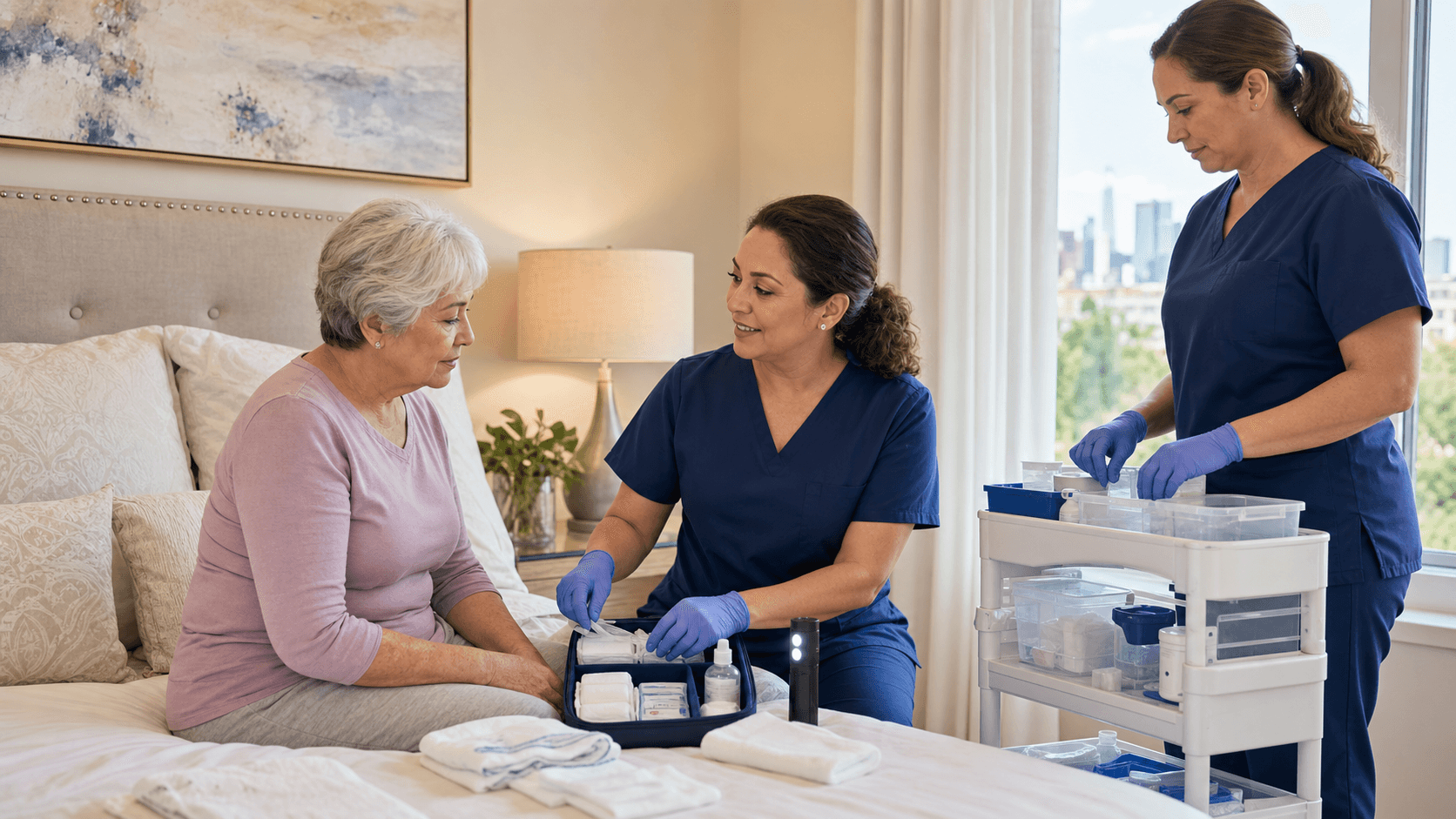
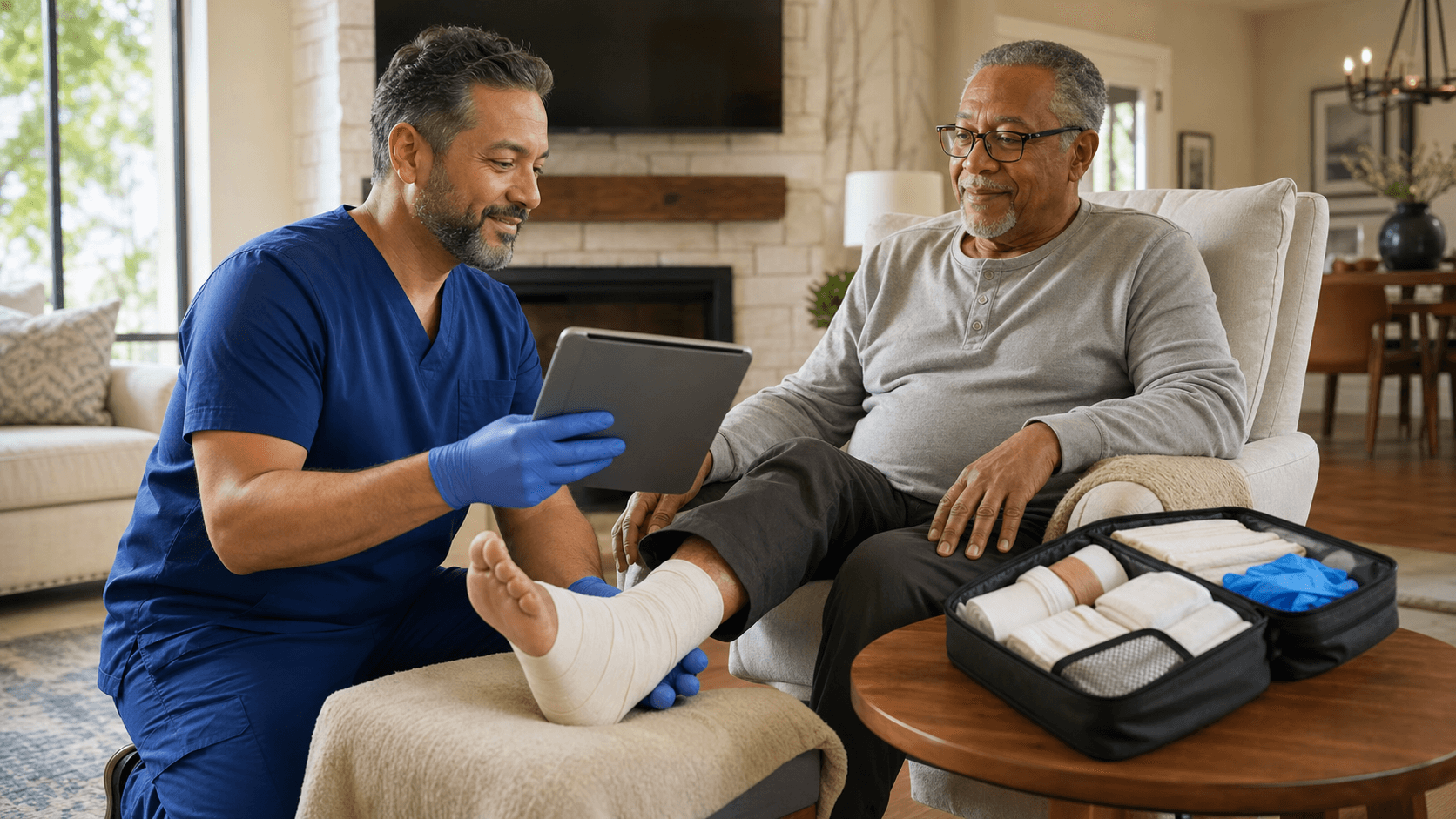
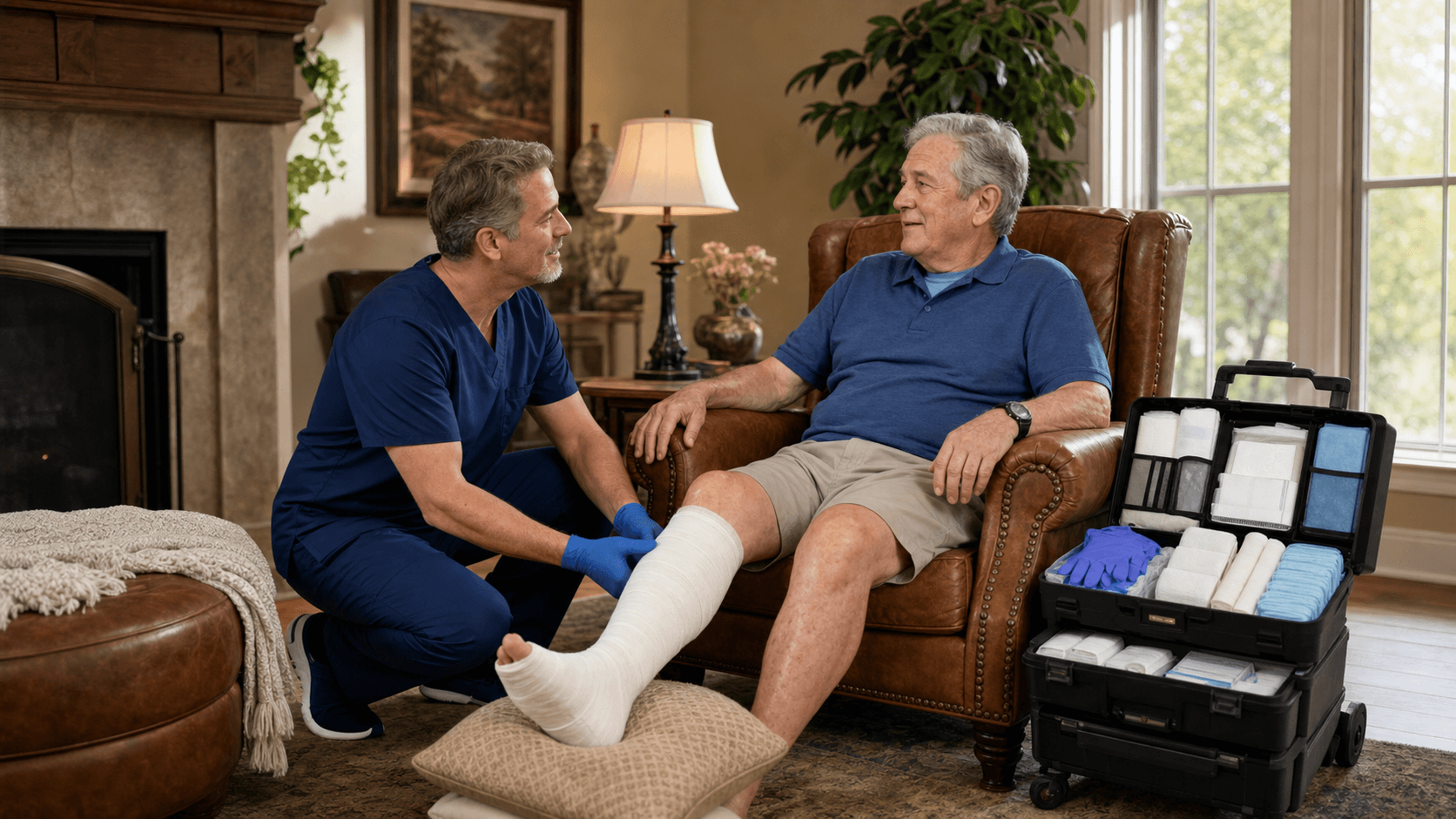
Mobile wound care means a medical team comes to your home, senior living apartment, or skilled nursing room to treat your wound. Care happens at your bedside instead of in a waiting room.
Benefits include:
- Less travel stress and fewer missed visits.
- Easier to keep compression wraps in place and adjusted.
- Faster dressing changes when leaking or pain increases.
- More consistent monitoring of your leg and overall health.
In the Dallas area, many patients use walkers, oxygen, or depend on family for rides. For them, care at home can be the difference between steady healing and repeated ER visits.
What Happens at a Bedside Wound Visit
A typical same-week mobile wound care visit for a venous leg ulcer in Dallas, TX, might include:
- Assessment of blood flow
Clinical fact: Your team checks pulses and may perform simple noninvasive tests, such as an ankle-brachial index or Doppler studies, to be sure arteries are open.[2]
Plain English: They make sure it is safe to use compression on your leg.
- Measurement and documentation
Clinical fact: The wound is measured, and depth, drainage, and tissue type are recorded.[1]
Plain English: They track whether the sore is getting smaller or larger over time.
- Debridement when needed
Clinical fact: Removing dead tissue helps healthy tissue grow and lowers infection risk.[1]
Plain English: They gently clean out the bad stuff so the good skin can fill in.
- Compression and dressings
Clinical fact: Multilayer wraps or stockings reduce venous pressure and support healing.[1]
Plain English: Compression works like an outside pump to push fluid out of the leg.
All of this happens at your bedside, so you can heal at home while a board-certified wound specialist manages the plan.
Mobile Care vs. Clinic vs. Hospital Stays
Here is a simple comparison:
| Aspect | Mobile wound care | Outpatient clinic | Hospital stay |
|---|---|---|---|
| Travel burden | Team comes to you at your bedside | You arrange transport each visit | No travel once admitted, away from home |
| Infection exposure | Limited to your home environment | Around other patients in waiting areas | Higher exposure to serious infections |
| Frequency of visits | Flexible, based on wound and schedule | Set appointment slots | Daily care in a higher-intensity setting |
| Access to advanced therapies | Debridement, compression, many advanced dressings | Adds options like graft placement and hyperbaric oxygen | Full inpatient services when you are unstable |
| Goal | Heal at home and avoid unnecessary hospital use | Outpatient care while you stay mobile | Stabilize serious illness or infection |
The goal is always the lowest-intensity setting that safely heals your venous leg ulcer and helps prevent unnecessary amputations.[2] Mobile teams can also coordinate clinic-based treatments like hyperbaric oxygen or graft placements when needed.
Insurance, Medicare Part B, and Pre-Auth Help
Many wound care services are Medicare Part B covered when they are medically necessary and ordered by a physician, based on current Centers for Medicare & Medicaid Services guidance.[3] Commercial plans and Medicare Advantage plans may need prior authorization.
When you work with a team like Anchor Wound Management, Dr. Brandon Elrod, DO, FAPWCA, and the staff handle documentation and pre-auth steps to help reduce delays. Having your insurance card handy when you first speak with the office makes it easier to confirm coverage and explain expected out-of-pocket costs before a mobile wound care visit.
Advanced Treatments for Venous Leg Ulcers in Dallas
Some venous leg ulcers heal with good compression, debridement, and infection control. Others need more advanced options that are available in clinic settings across Dallas and Fort Worth.[1]
Mobile wound care helps decide when to add those treatments and coordinates the move. That way you can get higher-level care when needed and still heal at home as much as possible.
Compression Therapy You Can Stick With
Compression is the core of venous ulcer care.[1] It can include:
- Multilayer compression wraps.
- Medical-grade stockings.
- Intermittent pneumatic compression pumps.
In simple terms, compression is like an external pump that helps blood move back toward your heart instead of pooling at your ankles. A mobile wound care team can fit wraps at your bedside, adjust them if they pinch, and teach you or your caregiver how to protect them between visits.
Debridement, Grafts, and Hyperbaric Oxygen
Debridement removes dead or infected tissue so healthy tissue can fill the wound.[1] For many patients, this can be done safely at the bedside with proper tools and pain control.
Some stubborn ulcers benefit from:
- Cellular and tissue-based products (grafts) that provide a framework for healing.[1]
- Hyperbaric oxygen therapy (HBOT), which exposes tissues to high oxygen levels to support certain chronic nonhealing wounds, as supported in wound care literature.[4]
Not every venous leg ulcer needs HBOT or grafts. A board-certified wound specialist decides based on your blood flow, infection status, and how the wound has responded so far.
Preventing Recurrence After Your Ulcer Heals
Studies show that many venous leg ulcers can come back if nothing changes after they heal.[1] The good news is that simple daily habits help lower that risk.
Plain English prevention plan:
- Wear long-term compression as directed.
- Elevate your legs during the day when you can.
- Walk regularly to keep the calf muscle pump active.
- Work on weight and fluid management with your medical team.
- Keep follow-up visits with your vein or vascular provider.
Mobile wound care check-ins or occasional clinic visits in Dallas, TX, can catch early skin changes like new staining or itching before another sore opens.
A Veteran's Perspective on Discipline and Healing
Wound care often comes down to steady habits. As Dr. Brandon Elrod, DO, FAPWCA, Captain, US Army (Ret.), explains, "Healing a chronic wound takes the same discipline as a good field plan. Clear orders, consistent follow-through, and honest feedback are what move you forward."
That "field plan" at home might be your wrapping schedule, your leg elevation routine, and the timing of your medicines. The medical team brings clinical skill and respect, and you bring your goals, your daily reality, and your willingness to follow the plan so you can heal at home.
FAQs About Mobile Wound Care in Dallas
Q1: How fast can I be seen for a venous leg ulcer in Dallas, TX?
A1: Many patients can be seen the same week, depending on location and appointment demand. If your symptoms are severe or changing quickly, you should still use emergency services when needed.
Q2: Is mobile wound care Medicare Part B covered?
A2: Many wound care services are Medicare Part B covered when they are medically necessary, but exact coverage varies by plan and diagnosis.[3] It is best to have the team review your benefits before the first visit.
Q3: Can you treat my wound bedside in assisted living?
A3: Yes, mobile wound care can be provided in private homes, assisted living, and skilled nursing rooms, working closely with facility nurses and staff.
Q4: What if I already have a primary care doctor or home health nurse?
A4: The mobile wound care team focuses on your leg ulcer and related circulation issues, then shares updates with your current providers. It is a team-based approach, not a replacement.
Q5: Will this keep me from needing an amputation?
A5: No one can promise a specific outcome. Early, consistent wound care and proper circulation testing can lower amputation risk for many people.[2]
Q6: What will I need to do between visits to heal at home?
A6: You will need to protect your dressings, keep compression in place as instructed, elevate your legs, take prescribed medicines, and watch for signs of infection or sudden change. If something feels different, let your wound team know promptly.
Call to Schedule Mobile Wound Care Near You
To ask about same-week mobile wound care for venous leg ulcers near you in Dallas and Fort Worth, call Anchor Wound Management at ()-X or book online at . Our team will review your insurance, including Medicare Part B, and Dr. Elrod's staff will help with any needed pre-auth before your first visit so you can focus on healing at home.
References
[1] Wound Healing Society. Guidelines for the treatment of venous leg ulcers.
[2] O'Meara S, Cullum N, Nelson EA. Compression for venous leg ulcers. Cochrane Database Syst Rev.
[3] Centers for Medicare & Medicaid Services (CMS). Medicare Benefit Policy Manual, Chapter 15: Covered Medical and Other Health Services.
[4] Undersea and Hyperbaric Medical Society. Indications for hyperbaric oxygen therapy.
Take The First Step Toward Healing Your Leg Ulcer Today
If you or a loved one is struggling with a venous leg ulcer in Dallas, TX, Anchor Wound Management is ready to help you move toward lasting relief. Our team will evaluate your wound, recommend evidence-based treatment options, and create a personalized plan to fit your daily life. Reach out today through our contact page so we can schedule your visit and start working toward better healing outcomes together.