Meta tags
Diabetic Foot Care in Dallas: 5 Common Mistakes That Lead to Wounds
Key takeaways
- Most diabetic foot ulcers begin with small, avoidable mistakes — not sudden injuries.
- Daily foot checks, supportive footwear, and professional nail care prevent the majority of wounds.
- A "wait and see" approach to a small wound is the most dangerous habit for someone with diabetes.
- Wound specialists treat diabetic ulcers differently than primary care or urgent care — earlier referral leads to better outcomes.
- For patients who cannot easily travel, Anchor Wound Management offers bedside diabetic wound care across Dallas, Plano, Irving, and the wider DFW area.
If you have diabetes, your feet need attention every day. Nerve damage (neuropathy) can hide cuts, blisters, and pressure points. Poor circulation can slow healing once a wound appears. Together, those two factors turn small injuries into ulcers — and ulcers into the kind of serious infections that lead to hospital stays or amputation.
The good news: most diabetic foot wounds start with mistakes that are easy to fix once you know what they are. Here are the five most common ones we see in Dallas–Fort Worth, and the practical steps to avoid them.
Mistake 1: Skipping daily foot checks
If you have neuropathy, you may not feel a rock in your shoe, a blister from a new pair of shoes, or a small crack in dry skin. By the time you notice something, the damage is often already done.
A simple daily routine catches problems while they are still small:
- Sit in a well-lit area at the same time each day
- Look at the tops, soles, and heels of both feet
- Check between every toe
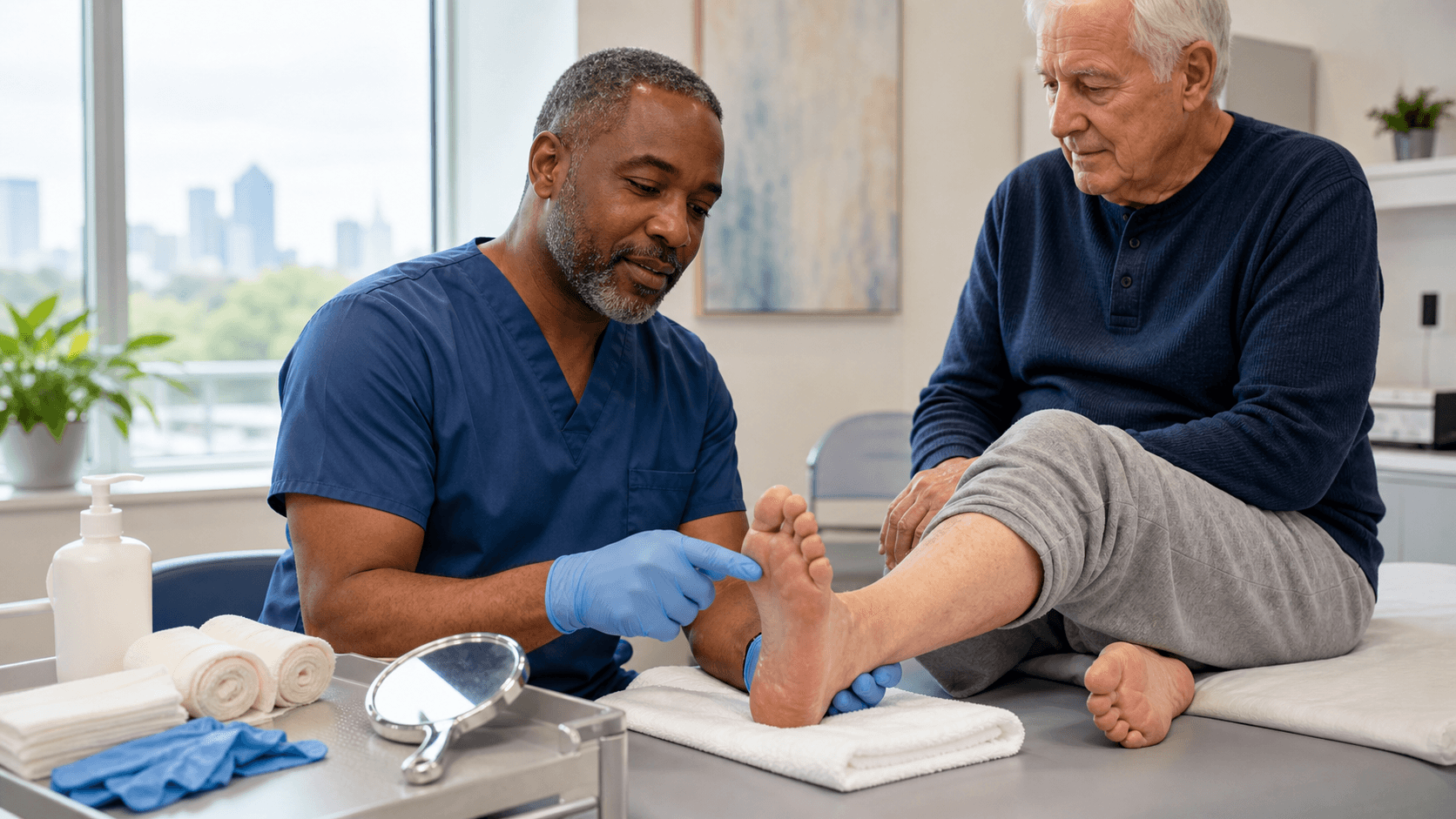
- Use a hand mirror or ask a family member to help with the soles
- Inspect around the toenails for redness, swelling, or fluid
Warning signs to watch for:
- Red spots, new dark areas, or skin that looks pale, blue, or shiny
- Swelling or warmth in one part of the foot
- Any cut, crack, blister, or callus
- Drainage on socks or bandages
- A new spot of pain, even mild — pain in a foot with neuropathy means something significant
If you see any of these, contact your provider the same day. Diabetic foot wounds rarely improve with waiting.
Mistake 2: Going barefoot or wearing unsupportive shoes
Walking barefoot at home, at the pool, or on grass is a common habit — and a risky one for anyone with diabetes. Thin sandals, slip-ons, and flip-flops have the same problem: no protection from hidden hazards and no support for the bones in your foot.
Common dangers include:
- Hot sidewalks, sand, or pool decks that can burn the soles of your feet
- Hidden objects (glass, thorns, sharp stones) you can't feel through neuropathy
- Straps that rub and create blisters between toes or across the top of the foot
- Flat, unsupportive soles that concentrate pressure on a single spot and cause ulcers
Safer choices:
- Closed-toe shoes with cushioned soles, ideally fitted by a podiatrist or pedorthist
- Moisture-wicking socks (synthetic or merino — not cotton)
- Water shoes at pools, lakes, and on decks
- House shoes or supportive slippers indoors — never go barefoot at home if you have neuropathy or a history of foot wounds
If you have had an ulcer before, ask about custom diabetic shoes. Medicare Part B covers one pair of therapeutic shoes and three pairs of inserts per year for qualifying patients.
Mistake 3: Trimming your own corns, calluses, or nails
Trying to do everything yourself is understandable — appointments take time, and the cuts seem small. With diabetes, the math is different. Limited vision, difficulty bending, or using sharp tools can cause cuts that are hard to see and slow to heal. A self-inflicted nick on the side of a toenail is one of the most common ways diabetic ulcers start.
Regular visits to a podiatrist or diabetic foot specialist in Dallas provide:
- Safe nail trimming that reduces the chance of ingrown nails and cuts
- Proper care of corns and calluses without damaging healthy skin
- Advice on shoe styles that match your foot shape and protect problem areas
- Custom inserts or offloading devices that shift pressure off high-risk spots
Anyone with diabetes should have a full foot exam at least once a year. If you have nerve damage, a past ulcer, or circulation problems, you may need exams every three to six months.
Mistake 4: Treating a small wound as "watch and wait"
This is the most dangerous habit on the list.
A blister, cracked heel, or shallow cut looks minor. With diabetes, it usually isn't. What looks like a small surface wound can already be the visible part of a deeper tissue breakdown — and once bacteria enter, infection can spread quickly through tissue that's poorly oxygenated to begin with.
A useful rule: if a foot wound isn't clearly improving within 24 to 48 hours, escalate. Don't wait a week. Don't try a third dressing change. The window between "minor wound" and "complex infection" can be days, not weeks.
Mistake 5: Going to urgent care or the ER instead of a wound specialist
Urgent care and emergency rooms are excellent for acute injuries and infections that need stabilizing. They are not built for chronic wound management. After the immediate problem is treated, you'll usually be sent home with a basic dressing and an antibiotic prescription — and the underlying wound conditions (pressure, circulation, infection control, debridement) often go unaddressed.
A wound specialist takes a different approach. The full toolkit includes:
- Debridement (removing dead tissue so healthy tissue can grow)
- Advanced dressings matched to the wound type
- Cellular tissue allografts that support the body's natural repair
- Hyperbaric oxygen therapy (HBOT) for wounds that aren't responding to standard care
- Offloading devices and pressure management
- Coordination with your primary care doctor, endocrinologist, and vascular team
For Wagner grade 3 or higher diabetic foot ulcers that haven't improved after 30 days of standard care, Medicare Part B typically covers HBOT — but only when ordered and managed by a qualified wound specialist. (See also:HBOT in Irving — costs and coverage.)
How to build a daily diabetic foot care routine
A written plan helps the daily habits stick. Yours might include:
- A set time each day for the foot check (after morning coffee or before bed both work well)
- Specific shoes assigned to specific activities (work, walking, errands, indoor)
- Daily skin care: gentle wash, full dry between toes, moisturizer on heels and soles (never between toes)
- Steady blood sugar management — uncontrolled glucose is the biggest risk multiplier for foot wounds
- Phone or calendar reminders for podiatry exams every 3 to 12 months depending on risk
- A pre-saved phone number for your wound specialist for the wound that doesn't improve
When to call a wound specialist in Dallas
Contact a wound specialist if any of the following happens:
- A foot wound is not visibly improving after 24 to 48 hours
- Redness or warmth spreads outward from a wound
- You see drainage, especially yellow or green, or notice a bad odor
- A wound keeps reopening in the same spot
- You have a history of past ulcers or amputations and notice any new skin change
- A new pressure point or callus is forming over a bony area
Earlier evaluation means more treatment options. By the time a diabetic wound is severe enough to threaten the limb, the options narrow sharply.
Bedside and mobile diabetic wound care across DFW
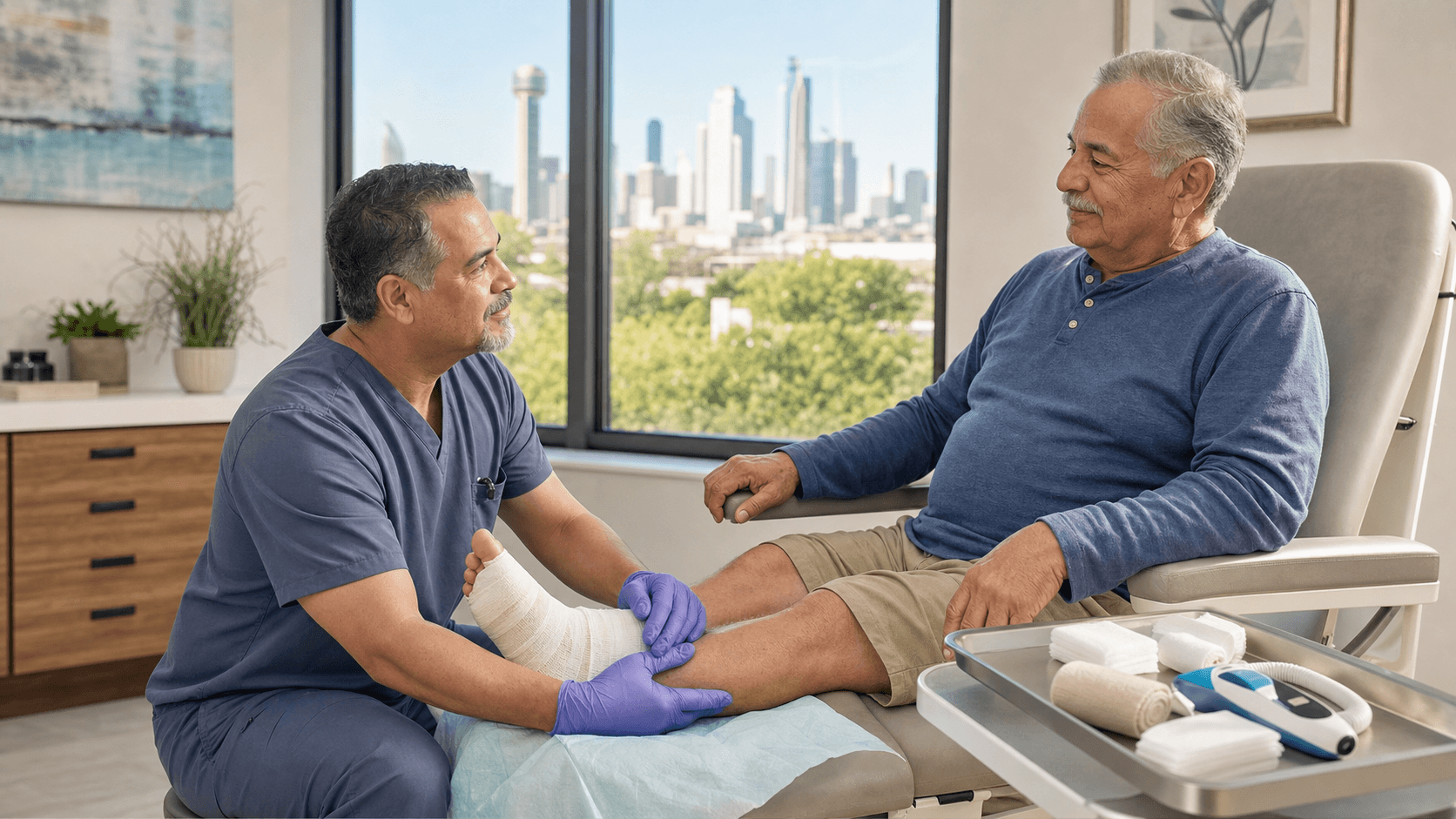
Many patients with diabetes — especially those with neuropathy, vision changes, or mobility limitations — find repeated clinic visits difficult. Anchor Wound Management offersmobile and bedside wound care across Dallas, Plano, Irving, Carrollton, Frisco, Allen, Addison, and the wider DFW area, including in senior living communities and hospice settings.
Most of a diabetic wound care plan — wound assessment, dressing changes, debridement, offloading, monitoring — can happen at the patient's bedside. HBOT and other in-chamber treatments happen at our Irving clinic. Medicare Part B typically covers in-home wound care when it is medically necessary.
Anchor Wound Management was founded byDr. Brandon Elrod, DO, FAPWCA, a former US Army Captain and Field Surgeon. The team focuses specifically on the wounds other providers find most challenging — often the ones complicated by diabetes, poor circulation, or limited mobility.
Frequently asked questions
How often should I have my feet checked by a specialist if I have diabetes?
At least once a year for a full foot exam if you have no current issues. Every three to six months if you have neuropathy, a history of ulcers, or circulation problems. More often if a wound is actively healing.
What's the difference between a podiatrist and a wound care specialist?
A podiatrist focuses on the foot and ankle — routine care, structural problems, biomechanics. A wound care specialist focuses on non-healing wounds anywhere on the body, using advanced techniques like HBOT, cellular tissue allografts, and complex debridement. For a diabetic foot ulcer that isn't healing, you often want both.
Does Medicare cover diabetic foot care?
Yes. Medicare Part B covers preventive foot exams for diabetics with neuropathy (one exam every six months), therapeutic shoes and inserts for qualifying patients, and most diabetic wound treatments when medically necessary, including HBOT for Wagner grade 3 or higher ulcers.
How quickly should a small diabetic foot wound heal?
A small, uncomplicated wound on a healthy diabetic foot typically shows clear improvement within 48 to 72 hours. If you don't see visible improvement in that window, call your wound specialist. Diabetic wounds that take weeks to heal often have an underlying issue (poor circulation, infection, repeated pressure) that needs professional treatment.
Can I get diabetic wound care at home?
Yes. Anchor Wound Management provides bedside wound care across DFW, including in senior living and hospice settings. Most of a wound care plan can be delivered at home; the exceptions are HBOT and certain in-chamber treatments, which happen at our Irving clinic. Medicare Part B typically covers medically necessary in-home wound care.
What's the warning sign that means I need to go to the ER, not the wound clinic?
Spreading redness with fever, severe pain, blackened tissue, foul-smelling drainage, or signs of systemic infection (confusion, low blood pressure) are emergency findings. Go to the ER. A wound clinic is the right call for a non-healing wound that's stable but not improving — not for an acute infection that's already spreading.
Take the next step
The earlier a diabetic foot wound is treated by a specialist, the better the outcome. If you notice a wound that isn't improving — or you want a risk evaluation before one starts — call Anchor Wound Management at (940) 843-1455 orrequest an appointment online. Our team can see you in our Irving or Plano clinic, or come to your bedside anywhere in DFW.
Learn more aboutdiabetic foot ulcer treatment orDr. Elrod's approach to complex wound care.