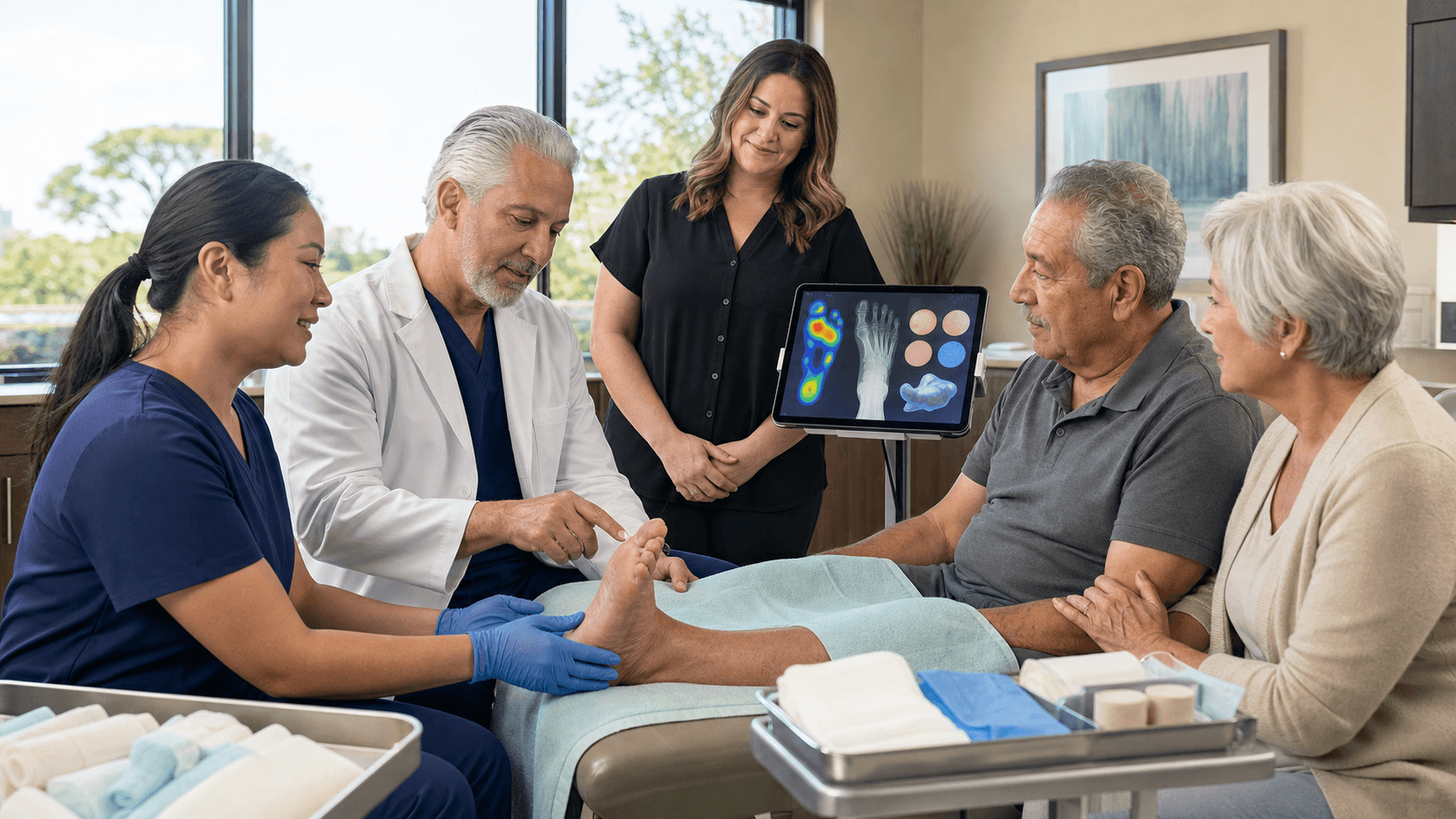
Diabetic Wound Center Rounds in Dallas: 5-Minute Decisions
Last updated: May 26, 2026
Editor's note: This article is for education only and is not a substitute for emergency care. If you notice spreading redness, high fever, confusion, trouble breathing, or sudden severe pain, call 911 or go to the nearest ER right away.
"Who really shows up when a diabetic wound team comes to my bedside, and what are they deciding about my foot in five minutes?"
People with diabetes ask this often because they want to avoid amputation, long hospital stays, and losing independence. Here in the Dallas area, a good diabetic wound center round, in clinic or through mobile wound care, is built to answer those concerns quickly and clearly. This article walks you through what actually happens in those few focused minutes, and how decisions at your bedside shape your plan to heal at home when it is safe.
Research reviewed by the CDC and limb preservation studies show that coordinated diabetic foot care with nursing, podiatry, vascular, and medical providers together lowers the risk of major amputation and repeat hospital stays.1,2 In plain English, when the team talks to each other while they are looking at your foot, you get faster decisions, fewer mixed messages, and more time healing instead of waiting. If you are searching for a diabetic wound center in Dallas, it is reasonable to ask who is on the team, how often they round on you, and if mobile wound care can start the same week you call.
Key Takeaways
- A strong diabetic wound program uses a team: RN, NP or PA, MD or DO, podiatry, and vascular, each with a clear role in keeping you safe at home.
- In the first five minutes, they decide if you are safe at home, what dressing you need, how to take pressure off, and if blood flow testing is urgent.
- Mobile wound care at your bedside can coordinate with clinic visits so you see a board-certified wound specialist without repeating the same story three times.
- Medicare Part B often covers home-based wound visits, debridement, and some supplies when medical rules are met, according to Medicare.gov.3
- The main goals are simple: help the wound close faster, prevent amputation, and keep you out of the hospital when it is medically safe to heal at home.
Who Walks Into the Room During Diabetic Wound Rounds
Clinical fact: Registered nurses watch your vitals, wound drainage, pain, blood sugars, and small skin changes that can signal infection or decline. Plain-English, your RN is usually the first one to say, "This looks different," "This smells off," or "You seem more tired today," then alert the rest of the team. What to do: When your RN asks detailed questions or takes photos, answer honestly and speak up about any new symptoms so that information shapes what every other provider decides.
Clinical fact: An NP, PA, or physician reviews your lab work, blood sugar control, medications, and infection risk, and follows evidence-based guidelines like the Infectious Diseases Society of America (IDSA) diabetic foot infection guidance.4 In plain terms, this is the medical quarterback who says, "We can keep treating this at home," or, "We need hospital care or urgent imaging." What to do: Bring a current medication list, your latest A1C if you have it, and any recent ER or hospital papers to every visit, clinic or mobile.
Clinical fact: Podiatrists focus on bone, joints, callus patterns, and shoes to find pressure points that keep breaking the skin and can lead to deep ulcers or bone infection. Plain-English, this is the foot and ankle expert who explains why that one spot under your big toe or heel keeps reopening. What to do: Expect talk about offloading devices like boots, special inserts, or sometimes small procedures, and ask, "How will this help me stay walking and still heal at home?"
Clinical fact: Vascular specialists evaluate circulation with tools like ankle-brachial index, toe pressures, and imaging, guided by American Heart Association and American College of Cardiology peripheral artery disease recommendations.5 Translation: If blood cannot get down to your foot, no surface dressing, ointment, or hyperbaric oxygen can work the way it should. What to do: If your wound has not gotten smaller after several weeks, ask, "Has anyone checked my blood flow yet?" and whether a vascular consult is needed.
At a diabetic wound center in Dallas, these roles may be on-site in clinic or coordinated across mobile wound care visits, vascular labs, and podiatry offices. Dr. Brandon Elrod, DO, FAPWCA, a board-certified wound specialist, leads a team-based approach to keep roles clear and decisions fast so you are not left waiting for answers. As Dr. Elrod explains, "When every provider at your bedside sees the same wound, the same labs, and the same home setting, we can make safer decisions in minutes instead of days."
What the Team Decides in the First Five Minutes
Clinical fact: Severe diabetic foot infections with spreading redness, high fever, tissue gas, or whole-body symptoms need urgent inpatient care to lessen the risk of sepsis and limb loss, as noted by CDC and IDSA resources.4,6 Plain-English, those first glances at your wound, your temperature, and your overall appearance decide if home is still safe or if you need the hospital today. What to do: If you feel suddenly worse between visits with chills, confusion, or new swelling, follow your emergency plan and seek help right away instead of waiting for the next round.
Clinical fact: Debridement, which means removing dead or infected tissue, lowers bacteria levels and helps modern dressings work and often needs to be repeated, according to Wound Healing Society guidance.7 Plain-English, the team decides on the spot if they should "clean it out" today, how deeply, and where it is safest to do it, at your bedside through mobile wound care or in a clinic room. What to do: Ask, "What is your goal for debridement today?" and "Is this Medicare Part B covered at home or in clinic for me?" so you understand both care and coverage.
Clinical fact: Dressing type, offloading tools, and visit frequency change with how wet the wound is, infection risk, and how fast it is shrinking. In simple terms, those five minutes set what goes on your foot, what goes off your foot in terms of pressure, and how often we see you. What to do: Ask, "How often will you be at my bedside?" "Can we plan a same week check?" and "What exactly should I do if this dressing leaks or loosens?"
Clinical fact: Poor blood sugar control, smoking, and untreated circulation problems slow healing and raise amputation risk, as shown in CDC and NIH research.1,2,8 Plain-English, the team can often tell quickly if the deeper problem is sugar, blood flow, or both. What to do: Expect clear, written targets, not vague advice, such as an A1C goal, a smoking quit referral, or a scheduled vascular test, and keep those notes somewhere you see daily.
Clinical fact: Hyperbaric oxygen therapy is recommended by the Undersea and Hyperbaric Medical Society and Medicare policy for certain long-lasting diabetic foot ulcers that have enough blood flow and have not improved with standard care.3,9 Translation: HBOT is not for every wound; the team will decide if your circulation and wound history make you a candidate. What to do: Ask, "Am I a good candidate for hyperbaric oxygen, and if not now, when might that change?" and check if your insurance or Medicare Part B may cover it.
How Bedside Decisions Shape Your Weekly Plan
Clinical fact: Daily offloading, checking your feet, and following dressing orders at home lowers infection risk and helps the wound close.2,7 In plain English, what the team decides in rounds becomes a morning and bedtime checklist that affects how you walk, bathe, sleep, and manage your blood sugar. What to do: Ask your RN or NP to write "daily wound orders" in simple language and keep them where you change the dressing so every caregiver follows the same plan.
The team also weighs where each part of care should happen. If your wound is stable, you have support at home, and you can follow instructions, more can be done through mobile wound care at your bedside. If infection risk is higher or you need special tools, clinic visits may be more frequent. What to do: Ask, "What parts of my care are safest at home, and what needs clinic-level equipment?"
Mobile Wound Care vs. Clinic Visits in Dallas: Comparison Table
Aspect
Mobile wound care at your bedside
Clinic visit at a diabetic wound center in Dallas
Travel and time
No travel; the team comes to you. Same week scheduling is often easier.
You travel to the center and may need a ride or help with transportation.
Monitoring
RN or NP sees your actual shoes, bathroom, and sleep setup in real life.
Providers see you in a controlled space but not your daily home hazards.
Procedures
Many debridements and dressing changes can be done at your bedside.
Some imaging studies and hyperbaric oxygen need clinic or hospital equipment.
Coverage
Often Medicare Part B covered when medical criteria from Medicare.gov are met.3
Also frequently Medicare Part B covered when the same criteria are met.
Best for
People with limited mobility, high fall risk, or strong desire to heal at home.
People who can travel safely and need more in-room technology or testing.
Clinical fact: For diabetic foot wounds in good care, research in peer-reviewed journals often looks for meaningful size reduction in the first weeks as a sign the plan is working.2,7 Translation: The wound should slowly get smaller, cleaner, and less wet, not sit the same size month after month. What to do: Ask for measurements in square centimeters and ask, "What will tell us this plan is not enough so we can change it quickly?"
Clinical fact: Some wounds do not fully close because of severe artery disease, deep infection, or other health issues. In plain English, sometimes the goal becomes preventing worse infection, lowering pain, and protecting function instead of total closure. What to do: If you hear terms like limb salvage, partial amputation, or palliative wound care, ask what each option means for walking, caring for yourself, and staying at home.
FAQ: Straight Answers About Diabetic Wound Rounds
Q: How fast should I be seen after I notice a new diabetic foot wound?
A: Clinical guidelines support early evaluation, often within a few days, to lower infection risk.4 Plain-English, do not "watch it" for weeks; call for a same week evaluation and seek emergency care if you see fast spreading redness, high fever, or feel very sick.
Q: Can mobile wound care really replace the wound clinic?
A: For many people, the safest answer is both. Stable parts of care can happen at your bedside, and higher risk steps or special procedures can happen in clinic based on your situation so you can heal at home when it is safe.
Q: What if I cannot tolerate debridement pain?
A: Clinical tools like topical numbing medicine, nerve blocks, and staged debridement can help.7 You do not need to suffer in silence, so tell your team before and during the procedure how you feel and ask what pain control options are available at home versus in clinic.
Q: How involved should my family or caregiver be in rounds?
A: Having one main support person at visits or on speakerphone helps prevent confusion and missed steps. They can help with dressing changes, rides, and medication reminders so the plan from rounds actually happens day to day.
Q: When is it time to consider amputation?
A: Amputation is usually considered only when infection threatens your life, the foot is no longer functional, or blood flow and wound care have not given enough result.2,4 The talk should follow clear updates on infection, imaging, and circulation so you understand why it is being discussed.
Q: How do I know if my current wound care is enough?
A: If weeks go by with no progress, no talk about offloading, no vascular testing, and no clear plan, it may be time to ask more questions. A coordinated diabetic wound center in Dallas that uses team rounds can offer a second look at your case and help you explore mobile wound care.
Ready to Explore Mobile Wound Care Near You in Dallas?
If you have a diabetic foot wound and want to heal at home when it is medically safe, our mobile wound care team can often see you the same week. Call our office at [PHONE NUMBER] or book online at [BOOKING LINK] to schedule a visit with Dr. Brandon Elrod and our team. We work with Medicare Part B and most major insurers, and when prior authorization is needed, Dr. Elrod's team handles pre-auth and paperwork so you can focus on healing.
- Centers for Disease Control and Prevention (CDC). National Diabetes Statistics Report.
- Armstrong DG, Boulton AJM, Bus SA. Diabetic Foot Ulcers and Their Recurrence. N Engl J Med. 2017;376:2367-2375.
- Medicare.gov. Medicare coverage of wound care and hyperbaric oxygen therapy.
- Lipsky BA et al. 2012 IDSA Clinical Practice Guideline for the Diagnosis and Treatment of Diabetic Foot Infections. Clin Infect Dis.
- Gerhard-Herman MD et al. 2016 AHA/ACC Guideline on the Management of Patients With Lower Extremity Peripheral Artery Disease.
- CDC. Sepsis and serious infections information.
- Wound Healing Society Guidelines for the Treatment of Diabetic Foot Ulcers.
- National Institutes of Health (NIH). Diabetes and Blood Vessel Disease.
- Undersea and Hyperbaric Medical Society. Indications for Hyperbaric Oxygen Therapy.
Get Advanced Care For Diabetic Wounds Today
If you or a loved one is struggling with a hard-to-heal ulcer, our team at Anchor Wound Management is ready to help with personalized bedside treatment. As a trusted diabetic wound center in Dallas, we focus on improving healing, comfort, and quality of life where you live. Reach out today to discuss your situation and let us recommend the next best step for your care, or contact us to schedule a visit.